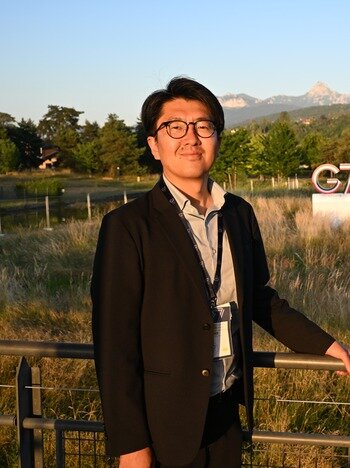
Paris Bureau Chief, The Asahi Shimbun B.A., then Division of International Studies, College of Liberal Arts, 2010
Shining a Light on Injustice to Change Society:
The Power of the Liberal Arts to Make Sense of Our Times
Witnessing Unreasonableness in Bangladesh and Finding My Calling in Journalism
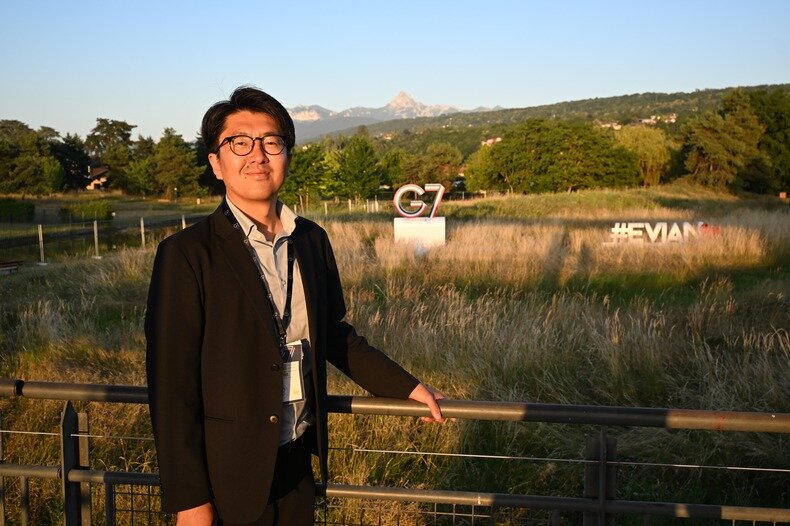
As a foreign correspondent and Paris bureau chief for The Asahi Shimbun, I cover news from across Europe, including France, Spain, and Italy, bringing stories to readers online and in print. My days are spent out in the field. In the summer of 2026, for example, I rushed to southern France, which was experiencing record-breaking heat, to report from the front lines of major wildfires. At the G7 summit in Évian that June, I also attended a press conference held by U.S. President Donald Trump and had the opportunity to ask him directly how the attacks on Iran should be assessed under international law. What draws me to this work is the chance to hear firsthand from people from all walks of life.
My desire to become a newspaper reporter began with my experiences in Bangladesh, where I spent my junior high school years. I saw children my own age living on the streets and scavenging through garbage discarded by my own household. I was shocked by the unreasonableness before me, and one thought left a lasting impression: if I had been born in that country, I could have been one of those children. I began to want a career that would allow me to listen to vulnerable people and help address the absurdity of the world.
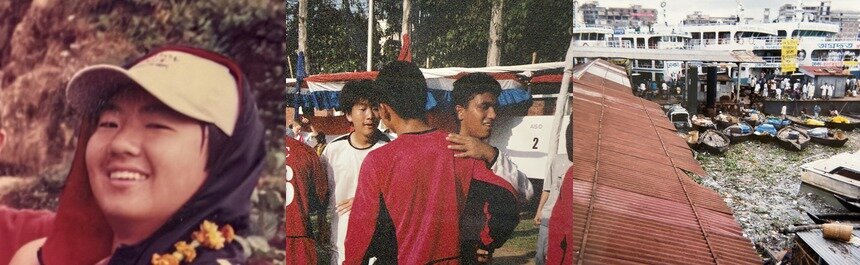
Left: Traveling in Nepal in Nov. 2001 (junior high school), Center: Dhaka, Bangladesh in Mar. 2003, Right: Dhaka, Bangladesh at that time
Later, at ICU, I met someone who would shape my future: Professor Toshiro Saeki, former chief editorial writer at The Asahi Shimbun. He taught media studies and other courses at ICU and led a journalism study group. He taught us that by uncovering unreasonableness and bringing it to public attention, we could change society little by little. His powerful message and the possibilities of journalism inspired me to pursue a career as a newspaper reporter. I still remember our in-depth discussions of why journalism matters, drawing on examples such as the Watergate scandal. The experience of learning to write and deepening my thinking continues to drive me today.
I also developed an interest in photography as a student. In my first year, I took a live-in job at a mountain hut at Mount Fuji's 8.5th Station, a tradition passed down through generations of students, mainly those living in ICU dormitories. I used the money I earned to buy an SLR camera. From then on, I loved taking photographs and spent many years working part-time as a photographer at amateur sporting events. I photographed children in action and took team pictures at youth baseball and soccer tournaments, selling the photographs to their parents. Since joining The Asahi Shimbun, I have often taken photographs on reporting assignments, and my desire to tell stories through images as well as words remains as strong as ever.
Firsthand Voices and Critical Thinking
The assignment that stands out most in my career is my reporting in Ukraine in May 2022. About three months after Russia launched its full-scale invasion, I stayed in the western city of Lviv. At the time, large numbers of civilians had been forced to shelter for more than two months beneath the Azovstal steelworks in Mariupol, a city in southeastern Ukraine that had come under fierce attack. I was able to speak directly with people who had escaped safely from the steelworks. Meeting people who had fought to survive in such brutal conditions, with the sound of bombing overhead, brought home both the unreasonableness of war and the strength of the human spirit. It was an assignment I will never forget.
Seeing and verifying for yourself what is happening on the ground is essential to reporting. In France, where wildfires had burned an area roughly the size of Tokyo's 23 wards, local firefighters told me, "These fires are clearly different in scale and intensity from those in the past." Each time I hear such firsthand accounts, I am reminded of the urgency of climate action and the need for the international community to work together to address the problem.
I believe a reporter's mission is to make increasingly complex international affairs accessible and to write articles that encourage readers to think for themselves about how world events relate to their own lives. The critical thinking I learned at ICU is indispensable to this work. Examining an event from multiple angles and continually asking, "Is that really true?" is the very process through which an article takes shape.
Today, with generative AI producing text and social media awash with information of uncertain reliability, critical thinking is more valuable than ever. AI is extremely useful as a tool to assist with background research and translation. Ultimately, however, it is people who go to the scene, listen to others, and corroborate what they hear. Ensuring the reliability of information is one of the major challenges facing the media. At the same time, every individual needs to approach information critically, checking it rather than simply taking it at face value.
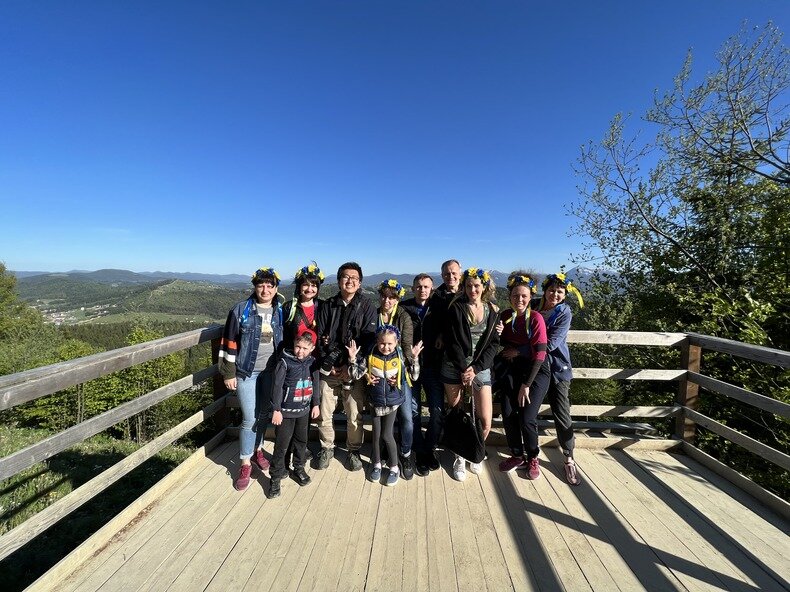
May 2022: Reporting from Ukraine with citizens who survived Azovstal (with local staff)
Venturing Beyond the Familiar and Broadening Your Education
ICU's greatest strength is its liberal arts education, which allows students to study widely beyond their own disciplines. I majored in economics, but I remember taking courses in all kinds of fields outside my major right up until graduation.
For example, in a Japanese Literature course taught by Professor Tzvetana Kristeva, originally from Bulgaria and now a professor emerita, I was captivated by the timeless human relationships portrayed in The Pillow Book and The Tale of Genji. What I learned about biodiversity in Ecology later sparked my interest in the culture of satoyama--landscapes shaped by the interaction of people and nature--during my regional postings, and also contributed to my interest in climate change. Observing a criminal trial as part of a Criminal Law course laid the groundwork for my crime reporting. Lectures by Professor Yoichiro Murakami, now a professor emeritus and renowned for his work on science, technology, and society, sparked my interest in today's AI-driven society. What I learned in Introduction to Christianity has also informed my current coverage of the pope at the Vatican. I believe ICU's liberal arts education gave me the foundation for taking an interest in a wide range of subjects.
Campus life outside the classroom was equally rewarding. From my first year, I took part in the ICU Intramural Soccer League (ISL), a longstanding lunchtime tradition. In my second and third years, I tried a new sport by joining the softball club with no previous experience. The friendships I formed with fellow club members--with whom I traveled to Vietnam, exchanged encouragement during the job-hunting process, and learned and grew--remain irreplaceable to me.
My advice to prospective and current ICU students is to venture into unfamiliar worlds and explore fields outside your interests, even if you already feel sure of the path you want to take. Through interviewing many people as a reporter, I have noticed that all the engaging people I have met who are at the forefront of their fields have a broad and deep education. Studying a variety of subjects nurtures your curiosity and deepens your understanding. That breadth becomes a strength when you face major challenges in society and need to discern what truly matters.
These days, social media and other platforms make it easy to surround ourselves with only the information we like. Yet information and perspectives that seem unrelated to our own lives can hold important insights. Newspapers are an excellent tool in this respect. As you turn the pages, let an article that happens to catch your eye introduce you to a new perspective or an unexpected discovery, and use those encounters to broaden your horizons.
Profile
Susumu Sakamoto
Paris Bureau Chief, The Asahi Shimbun
B.A. in Division of International Relations, College of Liberal Arts. 2010
After graduating from ICU, Susumu Sakamoto joined The Asahi Shimbun in 2010. Following postings in Fukuoka, Miyazaki, and Yokkaichi, he covered crime, accidents, and disasters for the Tokyo City News Department. He later worked in the Digital Editorial Department before moving to the International News Department in 2020. He has served as Paris bureau chief since the fall of 2025. Reporting from the front lines in Europe, he covers political and social developments, decarbonization efforts, and energy trends. Climate change will remain a key focus of his reporting in the years ahead.