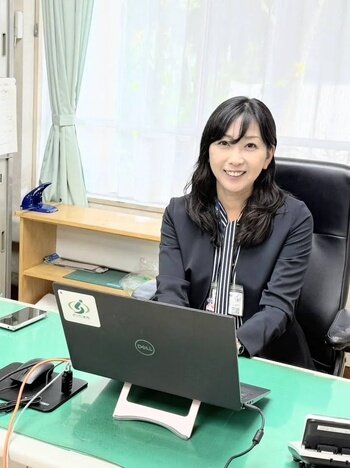
Principal, Saitama Municipal Oya Elementary School B.A., then Division of Education (Sociology of Education), College of Liberal Arts, June 2000
From School Counselor to Teacher, and Then to Principal Putting Children at the Center, Guided by What I Learned at ICU
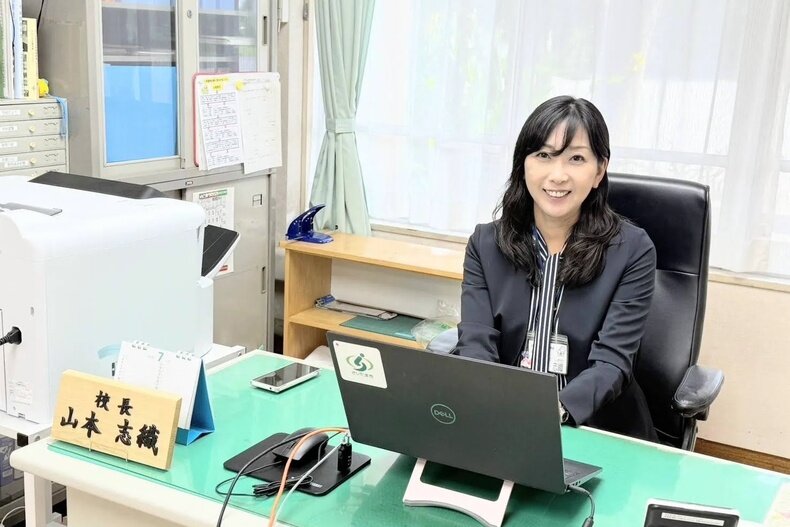
Two ICU Professors
Who Became My Role Models in Life
After graduating from ICU, I qualified as a certified clinical psychologist and worked as a school counselor before becoming a teacher. Today, I serve as an elementary school principal. The origins of this somewhat unusual career can be traced back to my junior high and high school years in the United States. In the spring of my third year of junior high school, my family moved to Georgia, and I enrolled in a local school without knowing what to expect. At the time, I spoke little English, and was unfamiliar with the cultural differences, so every day was a struggle simply to keep up with my classes.
What saved me during that period was the school counselor who was based at the school. She welcomed me despite my difficulty speaking English and conveyed with her whole being, "You are fine just as you are." Through her nonverbal empathy, she gave me an unwavering sense that it was all right for me to be there. Even on days when going to school felt difficult, I could tell myself, "I can make it through today because I'll get to see the counselor." That experience first sparked my interest in clinical psychology and counseling.
After returning to Japan, I entered ICU in September and began studying psychology, as I had long hoped to do. I remember taking a class taught by Professor Hidefumi Kotani and feeling deeply moved: "This is exactly what I wanted to learn!" Through lectures and role-playing exercises centered on Carl Rogers's theories, I gained a practical foundation in counseling. I read Professor Kotani's co-edited book, Guidance and Counseling: From Instruction to Collaboration Toward Self-Actualization (Hokuju Shuppan Ltd., 1993), so many times that the pages became worn. Professor Noriaki Tomabechi, who was then director of the Counseling Center, also had a profound influence on me. After taking one of his classes, I went to him for advice and told him directly, "I would like to work as a counselor someday." That conversation helped determine the path I would follow. Meeting two professors whom I respected deeply as people and who became role models in my life was, I believe, the most significant experience I had at ICU.
Although I immersed myself in psychology, I also took full advantage of ICU's liberal arts education by actively enrolling in classes in the arts, English literature, and other fields. Outside the classroom, I belonged to the volleyball team and devoted myself to training. During summer break, I also volunteered to provide learning support for children who were unable to attend school, working at an education support center and in a junior high school counseling room. These experiences remain among my most memorable. After graduating from ICU, I entered a master's program at another university and qualified as a certified clinical psychologist. I then began working as a school counselor.
Once I began working in schools, however, I encountered the limitations of the part-time school counselor's role. When a counselor comes in from outside only once a week, it is difficult to address the underlying causes affecting children who have emotionally depleted and stopped attending school. I became convinced that classrooms needed teachers capable of providing psychological care before children became so deeply hurt that they could no longer function. While continuing to work, I earned my teaching license through a distance-learning university and became an elementary school teacher at the age of 30.
Bringing a Counselor's Perspective to School Leadership
After working as a teacher and serving in roles at a board of education, I became principal of Saitama Municipal Oya Elementary School in April 2026. It is a tremendously vibrant school where approximately 1,000 children learn in an environment surrounded by abundant nature. My mission is to ensure that the children entrusted to our care return home safely and smiling every day, without injury or accident. I feel a profound sense of responsibility and fulfillment in the accumulation of those seemingly ordinary days.
Whenever I make my rounds through the school, the children came running up to me all at once, and we end up exchanging high fives all around. Perhaps because I do not quite fit the conventional image of a principal, some children initially told me, "You don't seem like a principal." I am gradually developing my own style as a principal, and I hope to be a principal who can remain close to every child and parent. At the heart of this approach is my perspective as a counselor. From my everyday interactions with children and the encouragement I offer to children who attend school but spend their days in a separate room, to my conversations with parents and school staff, I feel that my ability to listen serves me in every situation.
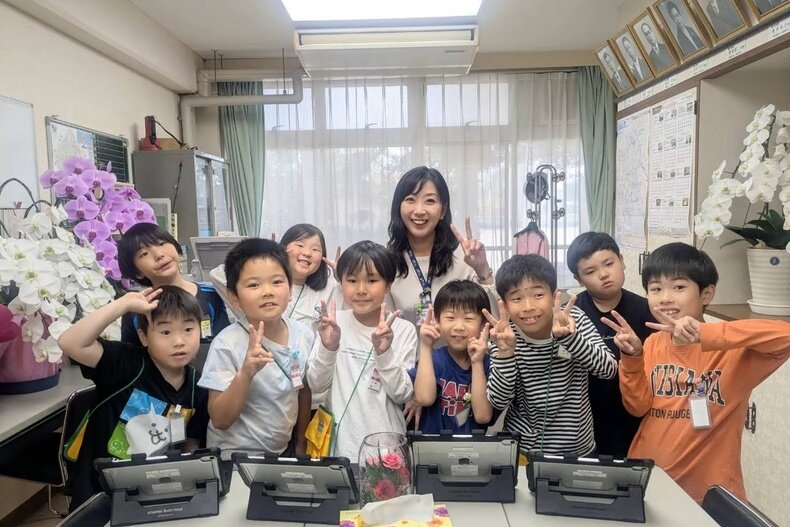
Saitama Municipal Oya Elementary School
Above all, the principle I value most in education is "putting children at the center." Schools have a responsibility to support the learning and growth of every child and to provide appropriate learning opportunities and environments without leaving anyone behind. How can we make that a reality? I continually ask myself this question as I conscientiously engage in school leadership each day.
Today, schools are expected to realize "proactive, interactive, and deep learning," in which children identify questions for themselves and deepen their thinking through dialogue with their peers. Rather than teachers conveying knowledge in one direction, each child should take ownership of their learning, deepening their understanding through exposure to a variety of perspectives. Through this kind of learning, I hope to cultivate the competencies children will need to thrive in an era of rapid change.
In recent years, cross-curricular learning that emphasizes connections among different subjects has also become increasingly important in elementary education. This approach reminds me of the liberal arts education I experienced at ICU and has given me a renewed appreciation of its value.
I believe that the mission of schools in the years ahead is to connect diverse forms of learning and create a richer educational experience while respecting the ideas and potential of every child.
Looking back on my time at ICU, most of my classes centered on dialogue and discussion in small groups. Clearly articulating my own views, listening attentively to the views of others, and building better relationships through communication--these are abilities I developed during my years at ICU. That is precisely why I want to create elementary school classrooms in which children can learn proactively and help one another grow.
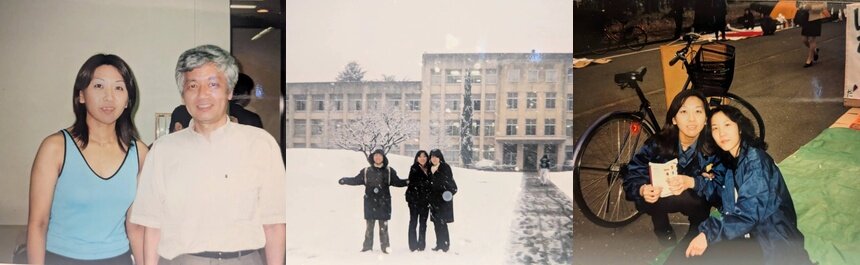
Left:With Prof. Noriaki Tomabechi/at the snowy Main Building/volleyball teammates
Engage with Diverse People,
Cultivate Your Sensibilities and Creativity, and Open New Doors
We are entering an unpredictable era in which anything can happen. I want children to become people who can determine for themselves what they need from the flood of information around them, formulate their own questions, collaborate with others, and create new value.
In recent years, Japan's elementary education system, with its emphasis on character development and collaboration, has earned considerable international recognition. One particularly distinctive feature of Japanese education is its "special activities" curriculum. Through class meetings, classroom responsibilities, student council activities, school events, and other activities, children think for themselves, discuss issues, build consensus, and shape their school lives together. These activities are highly regarded as a form of education that develops not only knowledge but also cooperation, social skills, and leadership.
Japan also has a culture in which children clean their own classrooms and schools. Although this practice is uncommon overseas, it has attracted attention as an educational activity that nurtures responsibility, public-mindedness, and consideration for others.
While carrying forward these aspects of education that cannot be conveyed digitally, I also want to create hybrid learning environments in which children can instantly connect with the world through tablet devices. As school non-attendance, bullying, and other challenges become increasingly serious, I want to recognize diverse learning options such as online education and alternative learning centers known in Japan as "free schools," while also providing as many children as possible with the rich experiences that can only be gained in the group setting that a school provides.
One of ICU's greatest attractions is its environment, which allows students to study across a broad range of disciplines without limiting themselves to a single specialization. It is a truly unique university where students can cultivate their sensibilities and creativity through engagement with students and professors from diverse backgrounds while expanding their own potential. More than a quarter of a century after graduating, I remain close to the friends I met at ICU. I hope that prospective and current ICU students will take full advantage of its exceptional environment and open many new doors for themselves.
Profile
Shiori Yamamoto
Principal, Saitama Municipal Oya Elementary School
B.A., then Division of Education (Sociology of Education), College of Liberal Arts, June 2000
Principal of Saitama Municipal Oya Elementary School. After graduating from ICU, Yamamoto completed the master's course in clinical psychology at Tokyo International University and qualified as a certified clinical psychologist. She later obtained the national Certified Public Psychologist credential. She worked as a school counselor at a junior high school and as an educational counselor before earning an elementary school teaching license through a distance-learning university. After working as a teacher, she served as a school education supervisor with a board of education, an elementary school vice principal, and a senior school education supervisor with a board of education. As of 2026, she leads a large school with approximately 1,000 students.