Facilities and Campus Map
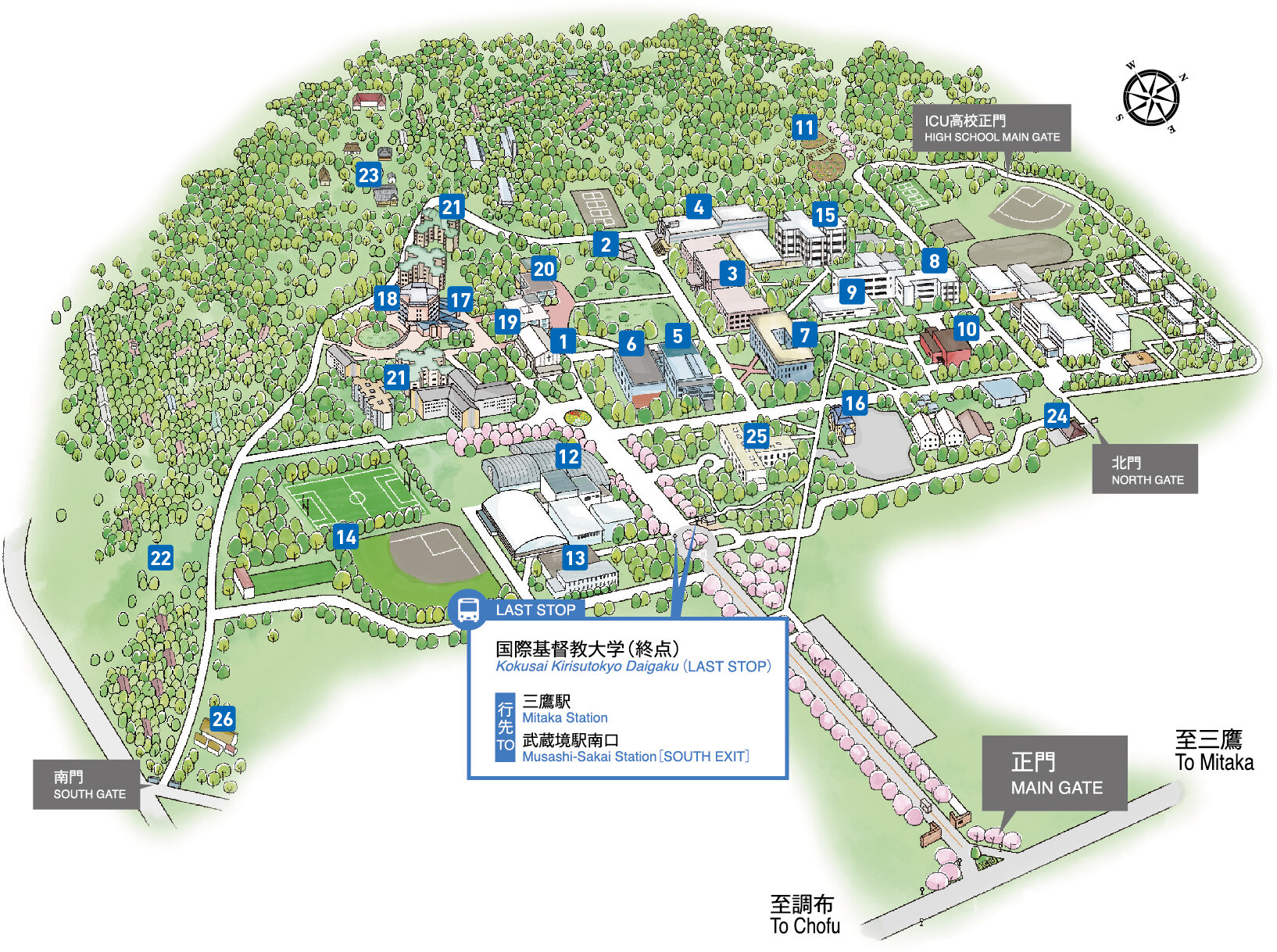
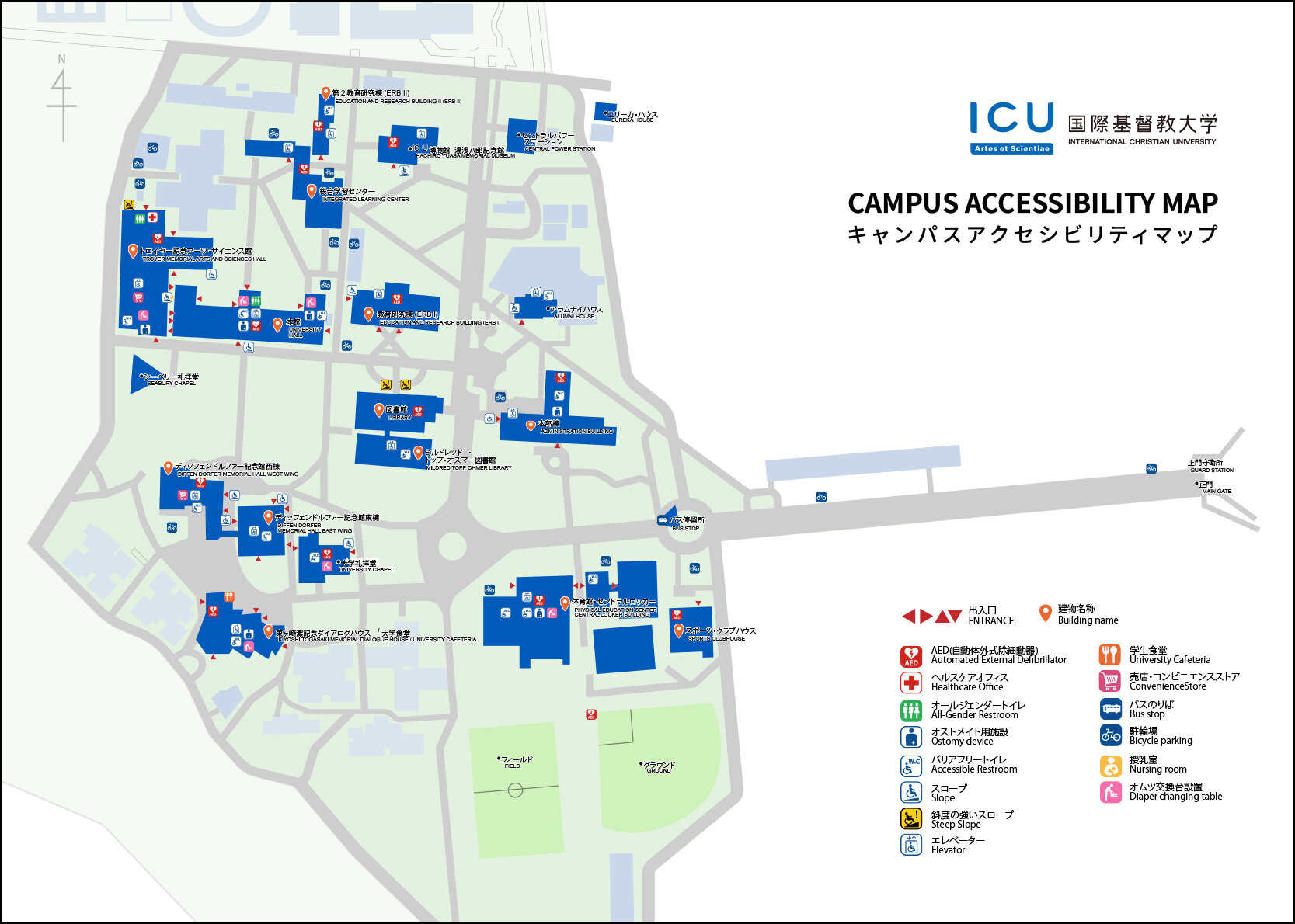
ICU is located on a campus of roughly 620,000 square meters. Our classroom buildings and research facilities are surrounded by the Musashino woods, dotted with student dormitories and faculty housing. The western side of the campus adjoins the Tokyo Metropolitan Nogawa Park. With its rich natural surroundings, ICU is a great place to enjoy the changing seasons. The Ministry of the Environment (MOE) certified our campus as a Nationally Certified Sustainably Managed Natural Site under the name of "ICU Mitaka Campus Woodland" in October 2023.
Notice of Relocation of Administrative Functions
As of July 17, 2026, the Administration Building and offices in several buildings were closed and relocated. Please check with each department for details.
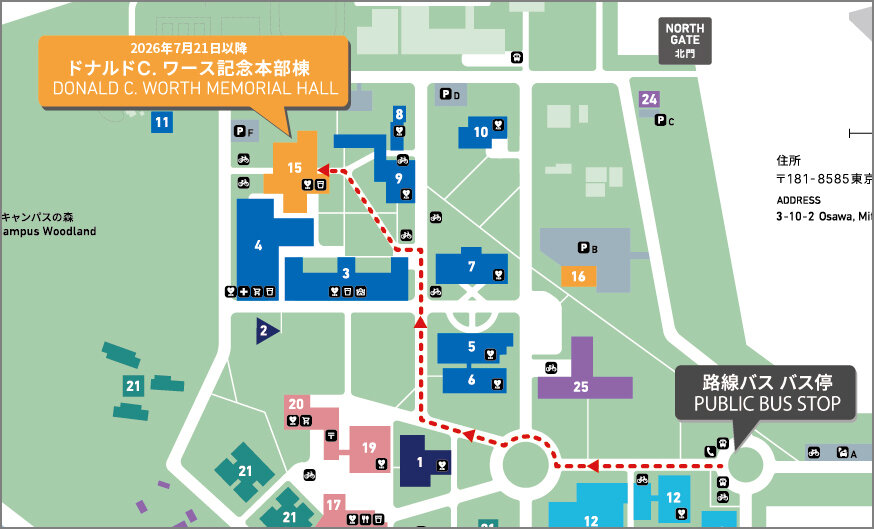
From July 21, 2026:
15Building 15: Donald C. Worth Memorial Hall (Building W)
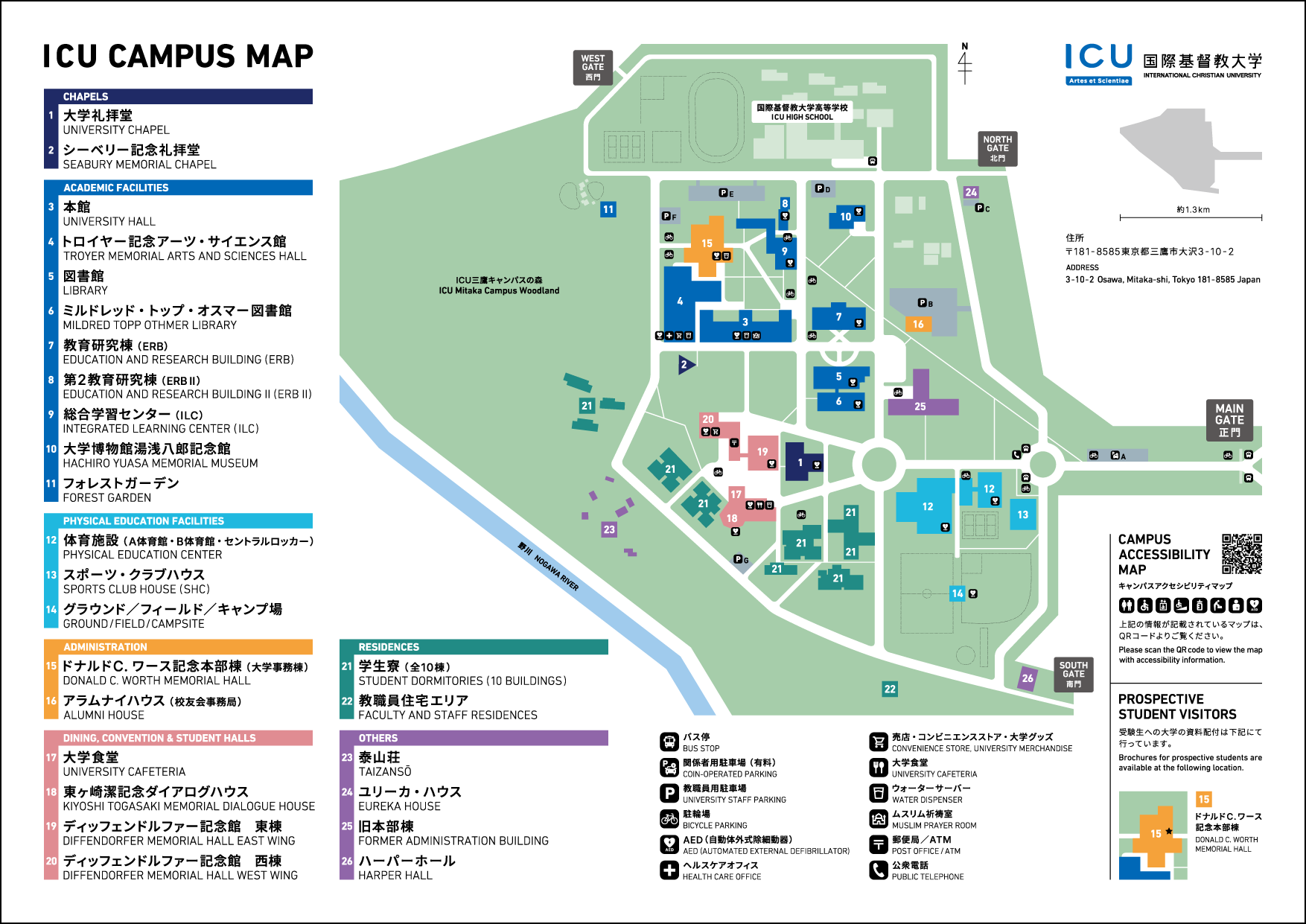
- 1University Chapel
- 2Seabury Memorial Chapel
- 3University Hall
- 4Troyer Memorial Arts And Sciences Hall
- 5Library
- 6Mildred Topp Othmer Library
- 7Education And Research Building(ERB)
- 8Education And Research Building Ⅱ(ERB Ⅱ)
- 9Integrated Learning Center(ILC)
- 10ICU Hachiro Yuasa Memorial Museum
- 11Forest Garden
- 12Physical Education Center / Central Locker Building
- 13Sports Clubhouse
- 14Ground / Field / Campground
- 15Donald C. Worth Memorial Hall
- 16Alumni House
- 17University Cafeteria
- 18Kiyoshi Togasaki Memorial Dialogue House
- 19Diffendorfer Memorial Hall East Wing
- 20Diffendorfer Memorial Hall West Wing
- 21Student Dormitories
- 22Faculty And Staff Residences
- 23Taizansō
- 24Eureka House
- 25Former Administration Building
- 26Harper Hall
1University Chapel
The ICU Chapel was constructed in 1954, and extensions were completed in 1960 (designed by W.M. Vories & Company / Raymond Architectural Design Office). The Chapel features a pipe organ built by Rieger Organs of Austria. Matriculation, Commencement and other ceremonies, as well as the Chapel Hour, are held in the Chapel. Sunday services of the ICU Church, which are independent from the university, are open to the local community.
Religious Center Website ICU Church Website
MacLean Avenue
MacLean Avenue is a 600-meter-long avenue connecting ICU's main gate and the University Chapel. It is named after Reverend John A. MacLean (Former Minister of the Ginter Park Presbyterian Church in Richmond, VA, and Honorary Doctor of Philosophy), who contributed greatly to the establishment of ICU. Roughly 70 cherry trees line both sides of the avenue - more than 100 including those around the area - which were planted in prayer for peace and neighborly love.

2Seabury Memorial Chapel
Named in honor of Ruth Isabel Seabury, who contributed greatly to the founding of ICU, the Chapel was completed in 1959 (designed by W.M. Vories & Company). Ceremonies and meetings with a small number of participants are held in this Chapel.

3University Hall
The current University Hall building originally housed the Mitaka Research Institute of the Nakajima Aircraft Company before the war. A fourth floor (designed by W.M. Vories & Company) was added to the original structure in 1953, and the outer walls were refurbished in 2003. It houses classrooms of various sizes where many classes are conducted. A major renovation including seismic retrofitting and preservation/restoration of the original 1953 design was conducted in AY2024, and classes have resumed from AY2025.

ICU Sacred Music Center
Established in 1977, the Sacred Music Center (SMC) took over the responsibilities of the Organ Committee that had managed and administered the Rieger Organ since its installation in the University Chapel in 1970. The SMC sponsors regular organ concerts, Christmas concerts and open lectures, and organizes private organ lessons for ICU students. The facilities at SMC also include two practice organs: the Arimasa Mori commemorative organ and the Noack organ.
ICU Sacred Music Center Website
Lawn Area
The lawn area in front of the University Hall is an oasis for students. Here they chat with friends, have a siesta, and sometimes even have classes under the blue sky.

4Troyer Memorial Arts and Sciences Hall
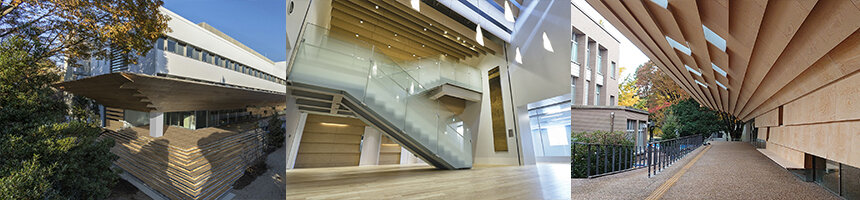
Completed in 2022 (designed by Nihon Sekkei, Inc. and Kengo Kuma and Associates), this four-floored hall houses offices for natural sciences and facilities for experiments, five large classrooms mainly to be used by first- and second-year students but open to all students, five research institutes of humanities and social sciences, namely the Institute for Educational Research and Service, Social Science Research Institute, Institute for the Study of Christianity and Culture, Institute of Asian Cultural Studies, and Peace Research Institute, as well as the Health Care Office.
The Hub Central is located in the center of the building as a symbolic place to create connections among people and to promote cross-disciplinary education and research. The Quadrangle (courtyard), connected to the Hub Central, extends between Troyer Memorial Arts and Sciences Hall, University Hall, Donald C. Worth Memorial Hall, and Integrated Learning Center.
5Library
Since its opening in 1960 (designed by Raymond Architectural Design Office / constructed by Taisei Corporation), the Library has always been at the center of the university's academic information services. Its collection of more than 790 thousand volumes in Japanese, English and other languages covers a multitude of subjects in response to the needs of the College of Liberal Arts and Graduate School. The main Library also houses the ICU Archives and Special Collections and the Learning Accessibility Services Office.
Library Website6Mildred Topp Othmer Library
In 2000, the new Mildred Topp Othmer Library was opened. This was the first library in Japan which introduced an automated book storage and retrieval system, integrating various information media such as books, journals, and electronic information to create an even more suitable learning environment.
On the ground floor of the Othmer Library, there is the study area and the Help Desk. The first floor houses the Center for Teaching and Learning, and it is where the center's office, the Writing Support Desk, the Group Learning Area, and Group Study Rooms are situated. The space beside the office is an area where students can meet with staff and student advisors called ICU Brothers and Sisters (IBS) to discuss matters related to academic planning.
7Education and Research Building (ERB)
Completed in 1978 (designed by Akira Inadomi), the Education and Research Building contains faculty offices, as well as the Center for Gender Studies and the Rotary Peace Center.

8Education and Research Building II (ERB II)
Completed in 1991 (designed by Shin Kenchiku Sekkei Jimusho), Education and Research Building II houses faculty offices and administrative offices.

9Integrated Learning Center (ILC)
Completed in 1981 (designed by K Structure Institute), the Integrated Learning Center is a university-wide common use facility. It houses regular classrooms, computer rooms, CALL (Computer Assisted Language Learning) classrooms, a Digital Media Lab designed for the creation of video and multimedia content, a computer-users' help desk, psychology laboratories, and faculty offices.

10ICU Hachiro Yuasa Memorial Museum
The Museum opened in 1982 to commemorate Dr. Hachiro Yuasa, the founding president of ICU. Its main collection consists of Japanese folk art items donated by Dr. Yuasa, such as ceramics, textiles and woodwork, as well as archaeological materials excavated on campus, ranging from artifacts from the Palaeolithic through the Jōmon eras. In addition to the permanent exhibition, the museum also holds three special exhibitions and open lectures annually. The Museum welcomes students to take courses related to the Curatorial Training Program conducted in the galleries, and invites all students as well as the general public to enjoy its exhibitions.
ICU Hachiro Yuasa Memorial Museum Website

11FOREST GARDEN
An area with active student club activities such as beekeeping, farming, and composting. Centered around a garden and vegetable patch, it offers a space for anyone to connect with food, agriculture, and nature. Equipped with bench tables for lunch, it serves as an interactive space outside of regular classes.
ICU Mitaka Campus Woodland12Physical Education Center / Central Locker Building
There are two gymnasiums on campus. Physical Education Center A, completed in 2018 (design supervision by Nihon Sekkei, Inc. and Kengo Kuma and Associates), houses the main court, a studio, and seminar rooms in which physical education lectures can be conducted. Physical Education Center B, completed in 1972 (designed by Akira Inadomi), houses rooms for ball games, martial arts, and weight training.
Other physical education facilities include a swimming pool completed at the same time as Physical Education Center A, and the Central Locker Building completed in 2001 (designed by W. M. Vories & Company Architects Ichiryusha), which houses locker rooms, shower rooms, and offices for faculty in the Physical Education Program. In addition, there are roofed tennis courts, a baseball field, a soccer/rugby field, and an archery range.

13Sports Club House
Completed in 1990 (designed and constructed by Taisei Corporation), the Sports Club House contains student sports clubrooms, locker rooms, and shower rooms.

14Ground / Field
An expansive outdoor sports and athletics space surrounded by rich nature, widely used for physical education classes and various extracurricular activities.
15Donald C. Worth Memorial Hall
Donald C. Worth Memorial Hall (formerly the Science Hall, completed in 1967) served as the center of education and research in natural sciences until AY2022. Its experimental facilities were transferred to the Troyer Memorial Arts and Sciences Hall in AY2023. After serving as a temporary classroom building during the University Hall renovation in AY2024, it will operate as the main administration building from 2026, housing administrative offices and meeting rooms including the President's Office, General Affairs, Financial Affairs, Personnel, Academic Affairs, and Student Services. It also distributes materials and handles inquiries for prospective applicants.
Individual Campus Visit16Alumni House
Completed in 2000 (designed by Raymond Architectural Design Office, Inc.), the Alumni House is a place for interaction between the university community and alumni. It houses the Alumni Association Office and the Alumni Lounge.

17University Cafeteria
Located on the first floor of Dialogue House, this cafeteria is widely used by students, faculty, and staff. It offers a space to enjoy meals while engaging in dialogue, taking in natural light from the surrounding seasonal environment.
18Kiyoshi Togasaki Memorial Dialogue House
Completed in August 2010 (basic design by GYA Architects Inc. / building plans by Nikken Sekkei), this multi-purpose facility combines the University Cafeteria, International Conference Room, Dormitory for Short-Term International Students, Dialogue House Residence for Visiting Researchers, and conference rooms.
This building houses the following offices:
- Counseling Center
- Housing Office
- University of California Study Center, Tokyo

19Diffendorfer Memorial Hall East Wing
Completed in 1958 (designed by W.M. Vories & Company), the East Wing is named in honor of Dr. Ralph E. Diffendorfer, who contributed greatly to the founding of ICU. Built as a community center for faculty and students, this building with three stories above ground and one below houses an auditorium, student clubrooms, and the Religious Center. The building was renovated in 2021. In February 2023, it was designated as a Registered Tangible Cultural Property as an outstanding example of post-war modernist architecture.

20Diffendorfer Memorial Hall West Wing
The West Wing was completed in 2000 (designed by W.M. Vories & Company Architects Ichiryusha). This building, with four stories above ground and one below, houses a soundproof music practice room in the basement, a lounge, store (convenience store), and multi-purpose hall on the first floor, conference rooms, ICU Service, and a lounge on the second floor, and student clubrooms on the third and fourth floors.
21Student Dormitories
ICU has ten student dormitories on campus, where 30% of our student body enjoys communal living.

23Taizansō
Registered Tangible Cultural Property (1999)
Taizansō has a history preceding ICU's foundation. It is comprised of six buildings designated as "Registered Tangible Cultural Properties" in 1999, including the Shoin, Machiai, and Kōfūki (a tea room and one-mat study "Ichijōjiki"). In particular, the "Ichijōjiki" is a rare historic structure associated with Takeshirō Matsuura (1818-1888), an explorer active from the Edo through Meiji eras. Currently, permission is required to visit or view Taizansō for conservation reasons.

Facilities in Other Locations
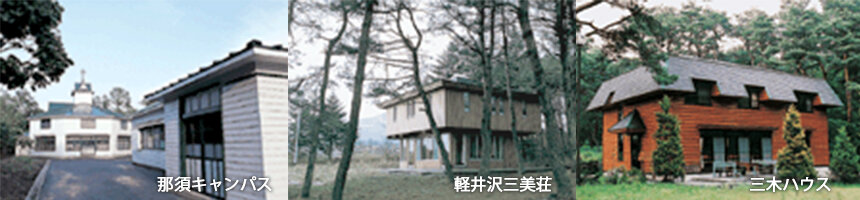
As well as ICU's main Mitaka campus, students are able to use the Sanbisō Retreat and Miki House near Karuizawa, Nagano Prefecture, and the Nasu Campus in Tochigi Prefecture during the summer for extra-curricular activities (Nasu Campus is currently unavailable for use).