

NEWS
2025 Faculty Retreat Held
Update: December 18, 2025
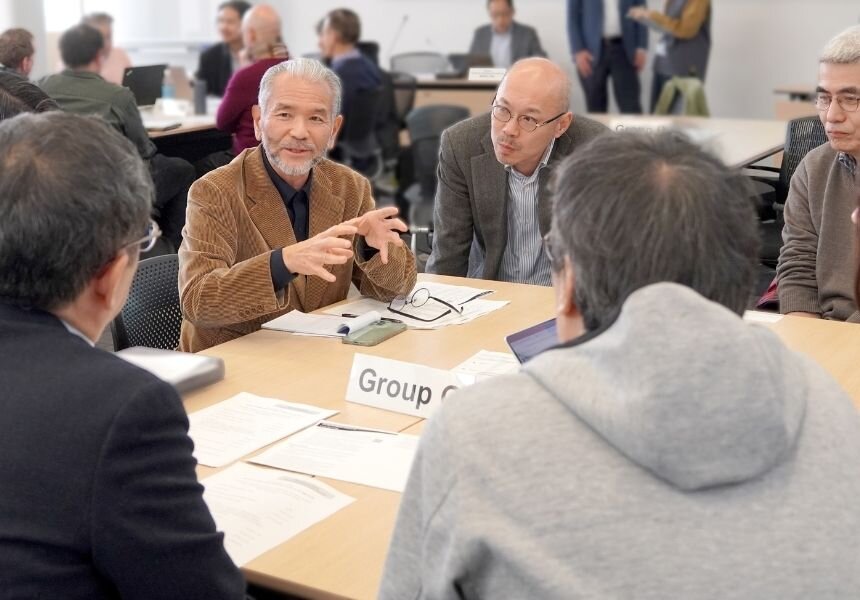
On November 12, 2025, the 2025 Faculty Retreat was held at the Kiyoshi Togasaki Memorial Dialogue House International Conference Room. At ICU, the Faculty Retreat is an annual training session held as part of its Faculty Development (FD) program, bringing together all academic staff. This year, the event was conducted entirely in person, with Vice President for Academic Affairs (VPAA) Robert Eskildsen serving as the moderator, and participation from approximately 130 faculty and staff members.
The theme for this year was "Thinking about Education at ICU in the Age of AI." The goal was to encourage a free and open discussion about how AI is reshaping higher education and how ICU can respond to this challenge while maintaining its liberal arts mission. Feedback obtained from this discussion will be used for the future development of FD guidelines and a new AI policy for the University.
Following the opening prayer, President Iwakiri provided Opening Remarks. The President emphasized that the event was a "retreat," not a regular meeting, designed for faculty to think freely and engage in active discussion about ICU's education. He stressed the uniqueness of the retreat's theme, which is linked directly to ICU's educational philosophy, distinguishing it from general discussions on "AI and university education." He expressed hope that the retreat would be a fruitful opportunity to share useful ideas.
The VPAA then gave an introduction, emphasizing that while ICU's core mission and philosophy must be maintained, the educational techniques at the University must change due to the rapid evolution of AI. He warned that the University cannot stand still because in the near future, students who have used AI tools since junior high or elementary school will be admitted to ICU. He positioned the retreat as a vital opportunity to explore how the University should approach this "changing reality." Following the VPAA's remarks, four faculty members delivered presentations related to the theme of the retreat.
Keisuke Ishibashi, Professor (Department of Natural Sciences): "Principles of AI and How to Approach It: An Information Science Perspective"
Professor Ishibashi explained that although large language models (LLMs) primarily predict the next word, the massive increase in parameters (trillions) and context length naturally suggests the emergence of "a kind of intelligence or thinking" that can internally summarize or structure text. He suggested that faculty should view this situation as an "opportunity" to fundamentally re-examine the purpose of human teaching. He proposed that instead of creating strict, unified University policies, engaging in dialogue with students regarding AI use is a better approach. On the other hand, some degree of guidelines regarding AI utilization will be necessary, and he suggested using an approach that frames the suitability of using AI based on where it aligns on an axis of whether a task requires efficiency/results/instrumental value (AI-friendly) or whether the task is better pursued through inefficiency/process/intrinsic value.
Daniel Janusz Marszalec, Associate Professor (Department of Economics and Business): "Numbermagic and the Genuine Mindlessness"
Associate Professor Marszalec noted that the labels of "artificial intelligence" and "data science" are intuitively attractive, and often lead students to expect that these technologies generate answers of comparable quality to a traditional scientific method. He noted that the tendency of accepting algorithm-generated answers simply "because the model said so" can be better labelled as "Numbermagic," since their scientific basis is often dubious. Instead, he contended that AI should primarily be used in ways where the results can be verified by the user. Furthermore, he presented the unique perspective that while in the past information had been getting "consistently cheaper to acquire," currently the proliferation of generative AI is causing the "cost of information" to increase: Differentiating information from noise or disinformation is becoming increasingly difficult. This phenomenon, he noted, is unlike our typical view of technological progress, where such regression is rare. He concluded that the key to dealing with the situation is not to enact strict regulations on student conduct, but rather to address the underlying "humanity question" which may drive the desire to immediately pick the easiest alternative. He made an appeal that to address the current situation we should encourage students to view their education as a "privilege and benefit" because such a view aligns with ICU's values and may lead to a more fruitful and sustainable engagement with whatever new technologies may emerge.
Daniel J. Brooks, Instructor (English for Liberal Arts Program): "Policy and Task Responses to AI"
Mr. Brooks discussed how instructors in the English for Liberal Arts (ELA) Program are responding to AI, highlighting two threads of conversation: Policy and task design. He discussed two challenges in writing policy: First, defining the very thing we are writing policy in response to (AI, generative, AI, digital tools, etc.), and second, defining the concept of appropriate use. He explains appropriate use in the context of formative assignments (e.g., brainstorming) and summative assignments (e.g., the final essay). Furthermore, Mr. Brooks discusses the importance of coordinating policy with task design, and presented two contrasting approaches: "Integrated" tasks, which require the use of AI (such as prompt engineering or critical evaluation of AI responses), and "ring-fencing" tasks, which make the use of AI impossible (such as oral defences or observed writing). Finally, he emphasised the importancd of coordinating policy design and task design, stating policy protects integrity; tasks preserve purpose.
Kei Nasu, Professor (Center for Teaching and Learning Director): "Ideas for AI-Resistant Course Redesign"
Professor Nasu pointed out that "transactional teaching/learning," which exchanges grades and credits for student deliverables, is being hollowed out due to its inherent affinity with generative AI technology. He then proposed four strategies to ensure that learning remains inherently valuable even in the Age of AI: 1) Focusing on the learning process, not just the final outcomes; 2) Fostering ownership of learning so students perceive it as their own; 3) Reversing the assessment methodology so that assignments and evaluations become the starting point of the learning process, not the endpoint; and 4) Implementing small size classroom environments to allow faculty to monitor the learning process more closely.
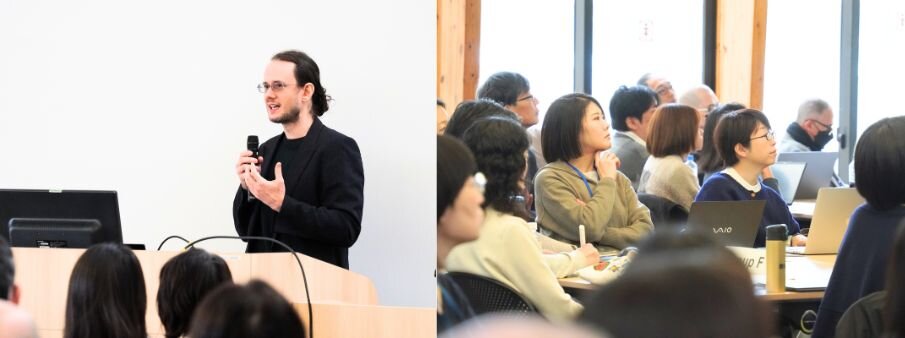
Following the presentations, 12 groups engaged in free and active discussion about the three main topics:
Topic 1:Appropriate Responses to AI that will Sustain ICU's Educational Mission
Topic 2:How to Adapt Courses and Syllabi
Topic 3:Addressing Ethical Issues in the use of AI
In the wrap-up session that followed the group discussions, additional thoughts were offered by the presenters and the Faculty Retreat Planning Committee members provided a general summary of the group discussions.
In the Closing Remarks, the Dean of the College of Liberal Arts, Professor Natsumi Ikoma, stated that fostering trust between faculty and students is indispensable for maintaining ICU's educational mission. Following this, she strongly encouraged participants to reflect once more on ICU's educational goals, as well as the goals of individual courses, and she emphasized the necessity of exploring new approaches to course management, tasks, and evaluation.
This Faculty Retreat provided an important opportunity for participants to recognize once again ICU's educational goals by considering how ICU's liberal arts education should respond to the transformations brought by AI, and the dialogue that ensued encouraged the participants to explore what they can do to achieve that mission. ICU will continue to maintain the fundamental premise of its commitment to liberal arts education, responding to the evolving educational environment caused by AI through dialogue, while incorporating the needs identified during the retreat, such as task redesign and emphasizing the learning process.
Feedback about the Retreat from the Participants:
・I realized the necessity of changing how we teach due to the spread of AI, and at the same time, I recognized the importance of returning to the fundamental philosophy of ICU's education. I understood that the importance of building trust with students, explaining things clearly in words, and avoiding making everything strictly black or white are things that will not change. I also want to strive to provide a better education by responding flexibly going forward.
・It was extremely meaningful to be able to discuss such a fundamentally important theme, both theoretically and practically, within the context of ICU's education.
・It provided an opportunity to re-examine the origins of what is fundamentally required in university education, language education, and liberal arts education.