

NEWS
Special Event Held Featuring NHK Japan Prize Winners
Update: December 17, 2025
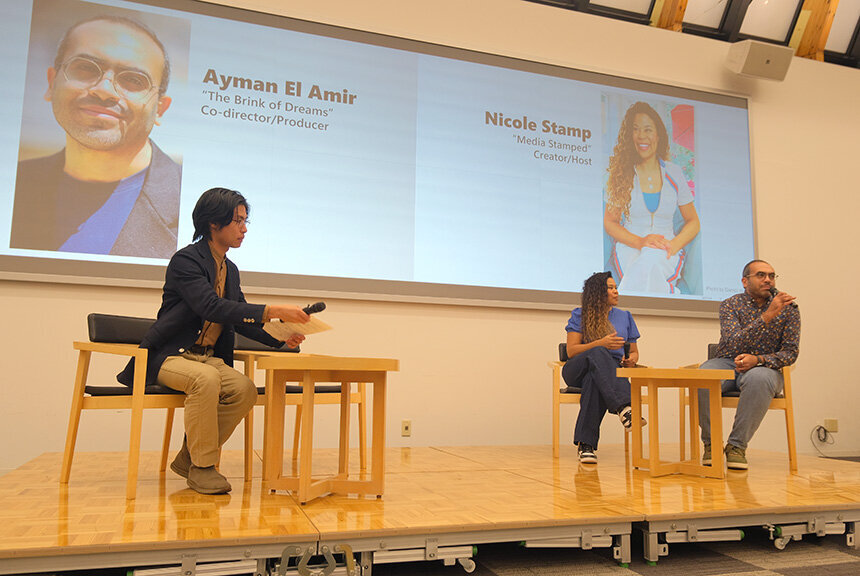
On November 21, 2025, the International Christian University (ICU) hosted a special event, "NHK JAPAN PRIZE - Screening and Talk with Award Winners at ICU," inviting winners of the Japan Prize, an international documentary contest organized by NHK. In addition to screenings of three award-winning works, two creators--one from Egypt and one from Canada--were welcomed to campus. Students engaged directly with works that sharply capture global social issues and, through dialogue with the creators, held passionate discussions on themes such as "the power of visual media to drive social change" and "how to interpret media information," gaining valuable opportunities to broaden their perspectives.
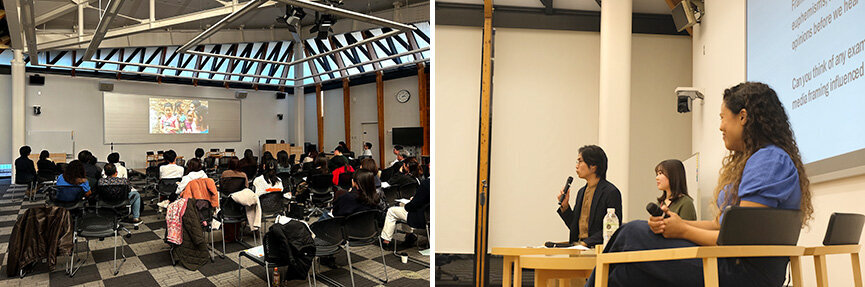
The event featured screenings of the following three documentaries, accompanied by talks from two award recipients about the backgrounds of their productions.
"The Brink of Dreams" - Producer Ayman El Amir Ayman El Amir, producer of "The Brink of Dreams," the winner of the Youth Category Best Work, took the stage. The documentary follows girls in a village in southern Egypt who defy traditional patriarchy to pursue their dreams, voicing dissent through performance and confronting the choices that shape their growth and lives.
"Media Stamped! What's in a Frame" - Host Nicole Stamp Nicole Stamp, host of "Media Stamped! What's in a Frame," which won an Excellence Award in the Pre-school Category, also made an appearance. The program explains the impact of information framing--how content is "cut" or presented--and teaches children how to analyze media critically.
Screening of the General Audience Category Excellence Award Film In addition to the two works above, "Walk the Line," an Excellence Award winner in the General Audience Category, was screened. This documentary follows a Singapore CNA correspondent accompanying Chinese citizens as they risk everything to travel through seven Central and South American countries in pursuit of migration to the United States.
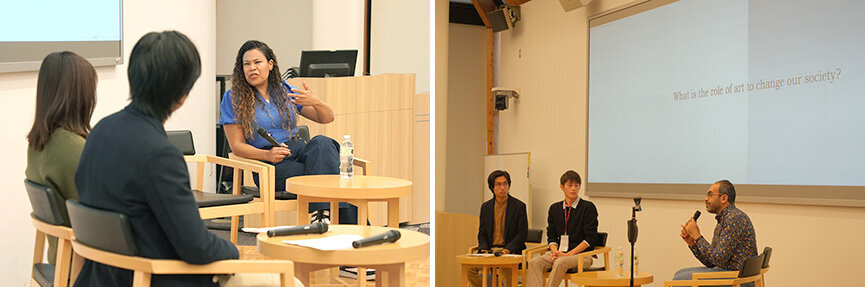
During the post-screening Q&A session with the creators, vigorous discussion unfolded on themes such as "the power of documentaries to effect social change" and "fairness in reporting."
Ayman El Amir of "The Brink of Dreams" spoke about the film's social impact. To build trust with the subjects, he explained that he spent four years "consciously becoming part of the community and building relationships of trust." He emphasized the potential of visual media to foster social transformation, noting that since the film's release, the traditional patriarchal culture of the village where the girls live has been "slowly changing from within."
Nicole Stamp of "Media Stamped" explained the mechanisms of information dissemination, pointing out that "the media is always framing." She advised viewers that by constantly asking "Who benefits from this information being broadcast?" they can prevent their opinions from being swayed by the media.
Regarding this theme, a graduate working as a journalist also shared reflections and dilemmas unique to those who report from the field. The graduate openly noted, "I suddenly realized that publishing an article always involves framing," and expressed a renewed awareness of how strongly media framing affects readers.
The discussion also delved into ethical issues surrounding the passive voice, which is frequently used in news reporting. For example, in coverage of conflicts or incidents, there is a decisive difference between the following two expressions:
Passive: "Many civilians were killed."
Active: "The army killed many civilians."
While the passive form appears to present an objective fact, it obscures the agent--"who" carried out the act--making responsibility harder to pinpoint. In contrast, when the sentence is written in the active voice as in the latter example, it becomes clear who the perpetrator is and where the responsibility lies. Another graduate similarly journalist pointed out that although the passive voice often used in Japanese reporting can appear "neutral," it also carries the danger of obscuring perpetrators' actions and responsibility. From a practitioner's perspective, participants examined how a single word choice can reshape society's understanding of accountability. Students also shared a variety of thoughts on "Walk the Line," which deals with refugee and migration issues. One student commented, "News often treats refugees and migrants as mere numbers, but through the film I was able to grasp just how difficult and harrowing each individual's life is." Regarding the so-called "refugee business"--the illegal facilitation of refugee movement--another student observed, "Although it is an illicit black-market operation, seeing how refugees travel while facing life-threatening danger makes it impossible to judge the business purely in terms of good or evil."
This event provided students with an extremely meaningful opportunity to engage with world-class educational content, enabling them to view global social issues as personally relevant and to deepen their empathy and understanding across cultures.
Text & Photos: Student, Sae Ozono