

NEWS
2026 New Year Chapel Hour
Update: January 8, 2026
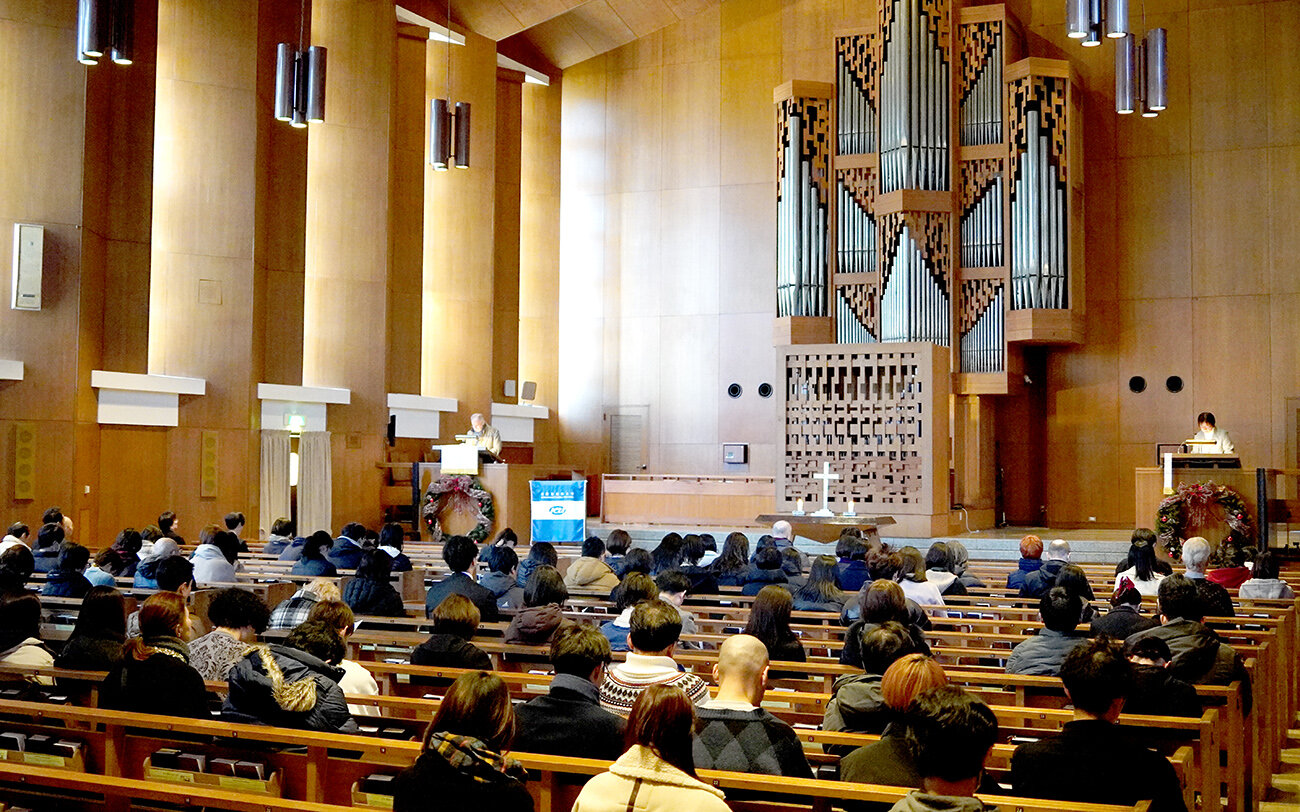
The 2026 New Year Chapel Hour was held at the university chapel on Tuesday, January 6, 2026.
The service, presided by Professor Jeremiah Alberg, Acting Director of Religious Center, began with the hymn "On this Day Earth Shall Ring" by all those in attendance, and continued with a Scripture Reading of Matthew 2:9-11.
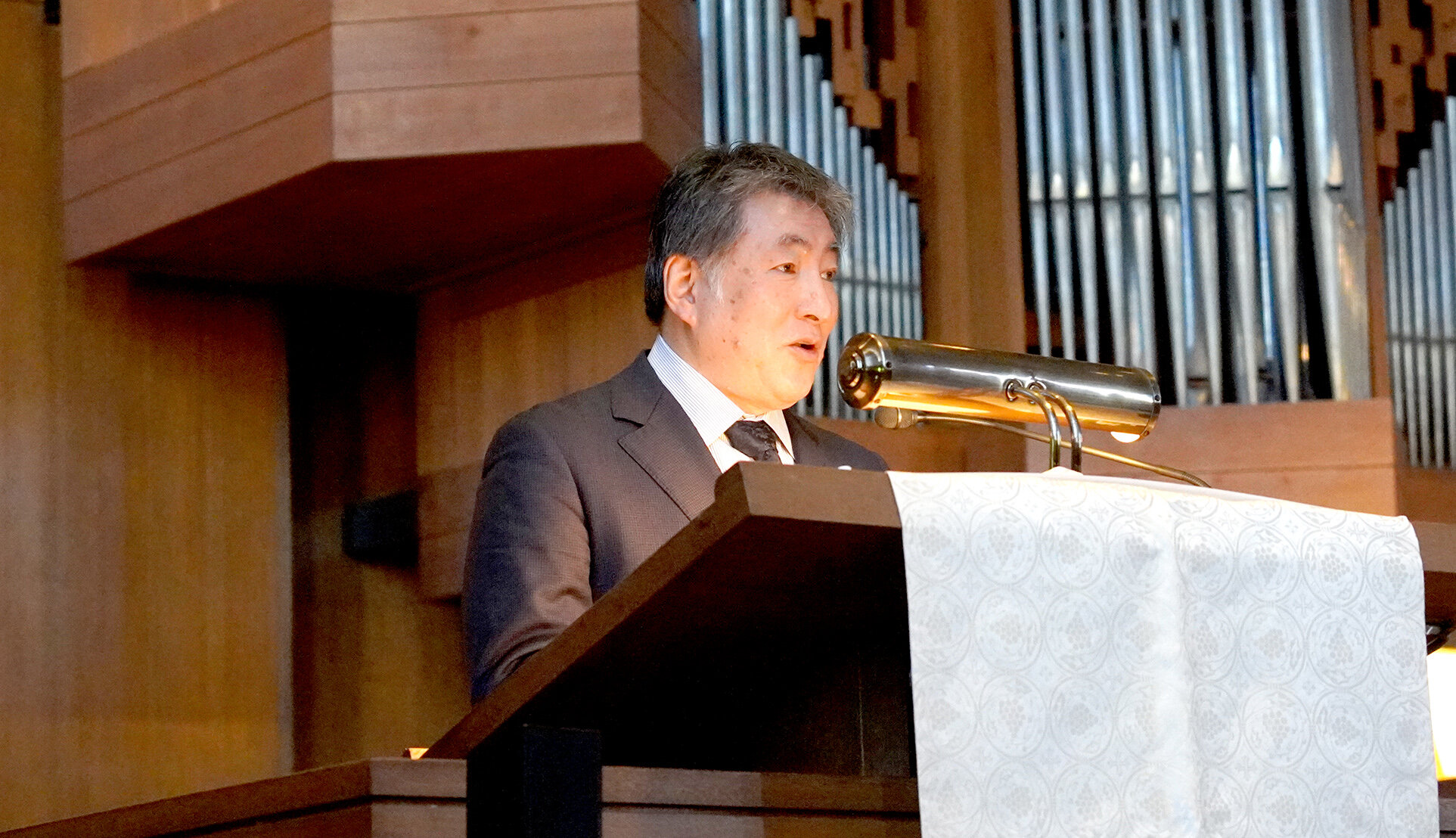
Following this, President Shoichiro Iwakiri delivered his message.
Full text of President Iwakiri's message is below.
"On the Day of Epiphany" Shoichiro Iwakiri, President
Happy New Year!
This year, the New Year Service coincides with Epiphany, commemorating the journey of the Magi from the East, who came to Bethlehem to honor the newborn Jesus, revealed as the Son of God. I give heartfelt thanks to God, who has graciously allowed us to gather in the chapel on this day of joy.
Today, some of you may celebrate Epiphany with a slice of Galette des Rois. I recall sharing this pastry on Epiphany in my class of French Literature in the winter term. Whoever discovers the small porcelain figurine, the fève, in their piece, is crowned with a golden paper crown. I can no longer remember whether the "Queen" or "King" kept the crown on throughout the session or set it aside partway through.
In Japanese, the first month of the year is called ichigatsu, a straightforward use of the number one. Its traditional name, mutsuki, evokes the month when family and relatives gather to renew their bonds at New Year's. In European languages such as English, January derives from the Roman god Janus, guardian of gates and thresholds, who presides over beginnings.
The poet Ovid, active around the time of Christ's birth, records in Fasti — his poetic calendar of Roman festivals spanning January through June — that " Janus appears ...to announce a happy year for you." (Ovid. Fasti. Book I (v. 64). Translated by A. S. Kline, Poetry in Translation, 2004.)
Ovid reminds us that in early Roman tradition March (Martius) was the beginning of the 10-month year: "March was the first month: the year began with Mars." (Ibid., Book III (v. 135).)
Ovid was born in 43 B.C., two years after the Julian calendar was introduced on January 1, 45 B.C. The second Roman King Numa Pompilius added January and February to the Roman calendar, while Julius Caesar upheld this tradition, officially designating January 1 as the start of the year. (Ninomiya, Takashi, « The Beginning of the Year », The World of the French Renaissance, Chikuma Shobō, 2000, p.423. (« Toshi no Hajime ni Tsuite », Furansu Runessansu no Sekai))
The inaugurator of the Julian Calendar was the Roman statesman Julius Caesar, immortalized by his declaration Alea iacta est ("the die is cast") upon crossing the Rubicon, and by the words Et tu, Brute? ("You too, Brutus?") uttered at his assassination in 44 B.C. Some of you may also be avid readers of his Commentarii de Bello Gallico (Commentaries on the Gallic War).
In Fasti Book I, Ovid asks Janus why the year starts in January:
"Tell me why the new-year begins with cold,
When it would be better started in the spring?
Then all's in flower, then time renews its youth,
And the new buds swell on the fertile vines:
The trees are covered in newly formed leaves,
And grass springs from the surface of the soil:
Birds delight the warm air with their melodies."
Janus' answer is brief:
"Midwinter's the first of the new sun, last of the old:
Phoebus (Apollo) and the year have the same inception."
Professor Ninomiya tells us that from the 14th century onward, in pre-Renaissance France, the start of the year was observed at different times depending on the region. In Paris and the northern regions, the year commenced at Easter, while in the south it was reckoned from Annunciation Day. Although the Julian Calendar was already in use at the time, the Catholic Church did not adopt January 1 as the year's beginning, preferring to avoid aligning a Christian observance with a date associated with pagan festivities. (Ninomiya, ibid., p. 424)
In this light, I cannot help but notice an intriguing affinity between Japanese custom and the Christian liturgical rhythm: Japan's fiscal year starts in April, a season that often aligns with Easter.
The Gregorian Calendar, which is now used worldwide, was introduced in 1582 by Pope Gregory XIII. The first Roman Emperor, Augustus, succeeded Julius Caesar — who had established the Julian Calendar — in ruling Rome. It was during Augustus's reign that Christ was born. The Roman Empire then flourished for the next two centuries in the era known as Pax Romana.
Janus is depicted as bicephalous, with two faces — one looking backward and the other forward — gazing upon what has already passed and what is yet to come at the same time. In ancient Rome, the Janus gate was opened at the onset of war and closed in times of peace, symbolizing the god's passage into the battlefield.
Jean Giraudoux, the French novelist and playwright active in the early 20th century, authored La Guerre de Troie n'aura pas lieu, a drama that captures the atmosphere on the eve of the Trojan War. He deliberately introduces an anachronism — there was no Janus Gate in Troy — when the Trojan hero Hector declares, "Close the gates," a symbolic declaration of peace. To this, his father King Priam replies: "Those close to us are prepared for war. Think carefully. I am not wrong. Even if you have the gates closed, we shall probably have to open them a minute later."
In response to the King, Queen Hecabe remarks, "One minute of peace is better than none."
Hector retorts to his father, "For men who have been fighting for months, peace means not being drowned in mud, but feeling their feet touch bottom... I don't care how small it is, let me stand on peace. I want to touch peace, if only with the tip of my finger."
To this, King Priam replies: "It is a sin to cast peace upon a city as one would cast poison into it.... Peace is a currency spun from memory, love, and hope. Soldiers buy the bread of peace, drink the wine of peace, embrace the woman of peace — and an hour later you will send them off to war."
Hector orders the gates shut and says, "There will be no war." (Giraudoux, Jean. Tiger at the Gates. Translated by Christopher Fry, Methuen, 1955, with our adaptations.) He then resorts to diplomacy by meeting with the Greek envoy Ulysses, framed as Troy's last chance to avoid war.
The denouement of the play is allusive. Hector and Ulysses seem to have reached an understanding that could avert war. But Trojan poet Demokos, a fiery advocate of war, rouses the people with his rhetoric and ruins all. He composes a martial song and exhorts them to take up arms. Enraged that Demokos has endangered his fragile hope for peace, Hector strikes him. But with his dying breath, Demokos utters a fatal lie: he claims that the Greek warrior Ajax, who has come to Troy with Ulysses, has killed him. The Trojans, inflamed by this deceit, cry out for vengeance, and thus the war with the Greeks is set ablaze.
The name Demokos derives from the root demos, signifying the people or citizens within a democracy. By brandishing the banner of heroism and rousing civic passions — anger, anxiety, and a sharpened sense of justice — they ultimately fling open the gates of ruin.
Living in our contemporary world, we cannot but pray that such a fate will not befall the democratic path we have chosen, a path meant to uphold freedom, peace, and blessing. We must strive to build a world of enduring memories, affection, and hope — rather than one that is fleeting.
Let us hope that in this first month of the year — the month of Janus, who gazes upon both the past and future, and the month of Epiphany, when the wise men from the East came to honor the infant Jesus — we may love God, humankind, and the world as Christ desired: surrounded by God's affection, reflecting on the past with humility, and embracing a clearer vision for the future. May the new year be one that empowers us to realize this vision through invention, discovery, and decisive action.
After Jesus had been born, crucified, and raised from the dead, the apostles Paul and Barnabas, while proclaiming the good news in a local region, performed a miracle by healing a man who had been lame from birth. When the crowd saw this, they exclaimed, "The gods have come down to us in human form," calling the apostles Zeus and Hermes and bringing bulls and wreaths to offer as sacrifices. But the apostles shouted, "Why are you doing this? We too are only human, like you. We are bringing you good news, telling you to turn from these worthless things to the living God." (Acts 14:11-18) Jesus also came to us in human form — God made manifest among humankind. Unlike a fleeting vision, he dwelt among us, shared in our suffering, and led us toward truth. Yet I believe the birth of a new faith must have been profoundly difficult in a world still bound by fervent devotion to gods like Zeus and Hermes.
This year, ICU will be establishing its 5-year midterm plan for 2026~2030. We will follow the path of our "living God" (Acts 14:15), so that our liberal arts education may foster learning and discovery, guiding us toward the creation of a society in harmony with both humanity and nature in a time of constant change.