

NEWS
ICU and Sophia University co-hosted a symposium titled "Toward Deep International Learning in Higher Education"
Update: January 16, 2025
President Shoichiro Iwakiri mentioned in the opening remarks that ICU and Sophia University participated in the OECD's international project entitled "Creative and Critical Thinking Skills in Higher Education" from 2019 to 2023 as the only university from Japan. He explained how the two university-team has empirically verified the deepening of interdisciplinary and international learning in the field of environmental studies, multicultural education, and service-learning.
Professor Masako Watanabe of the Graduate School of Education and Human Development, Nagoya University, gave a keynote lecture titled "The Cultural Foundations of Logical Thinking: Implications for In-depth International Learning at Universities in Japan", and Professor Kazuko Suematsu, Associate Executive Vice President Director and Director of Global Learning Center/ Institute for Excellence in Higher Education, Tohoku University, gave a lecture on "Design and Results of Intercultural Collaborative Learning at Tohoku University." Prof. Watanabe carefully explained the four types of logical thinking in Japan, the United States, France, and Iran based on specific examples, and multiple ways of thinking by understanding that creativity and critical thinking have different meanings depending on these thinking patterns, and that these patterns of thinking are deeply related to social and cultural backgrounds. She talked about the possibility of realizing in-depth dialogue and learning in an international and interdisciplinary manner. Prof. Suematsu clearly explained the vision and intention behind Tohoku University's comprehensive intercultural collaborative learning, the establishment of a system that enables interaction between various actors, and the development process of the Rubric for International Collaborative Learning.
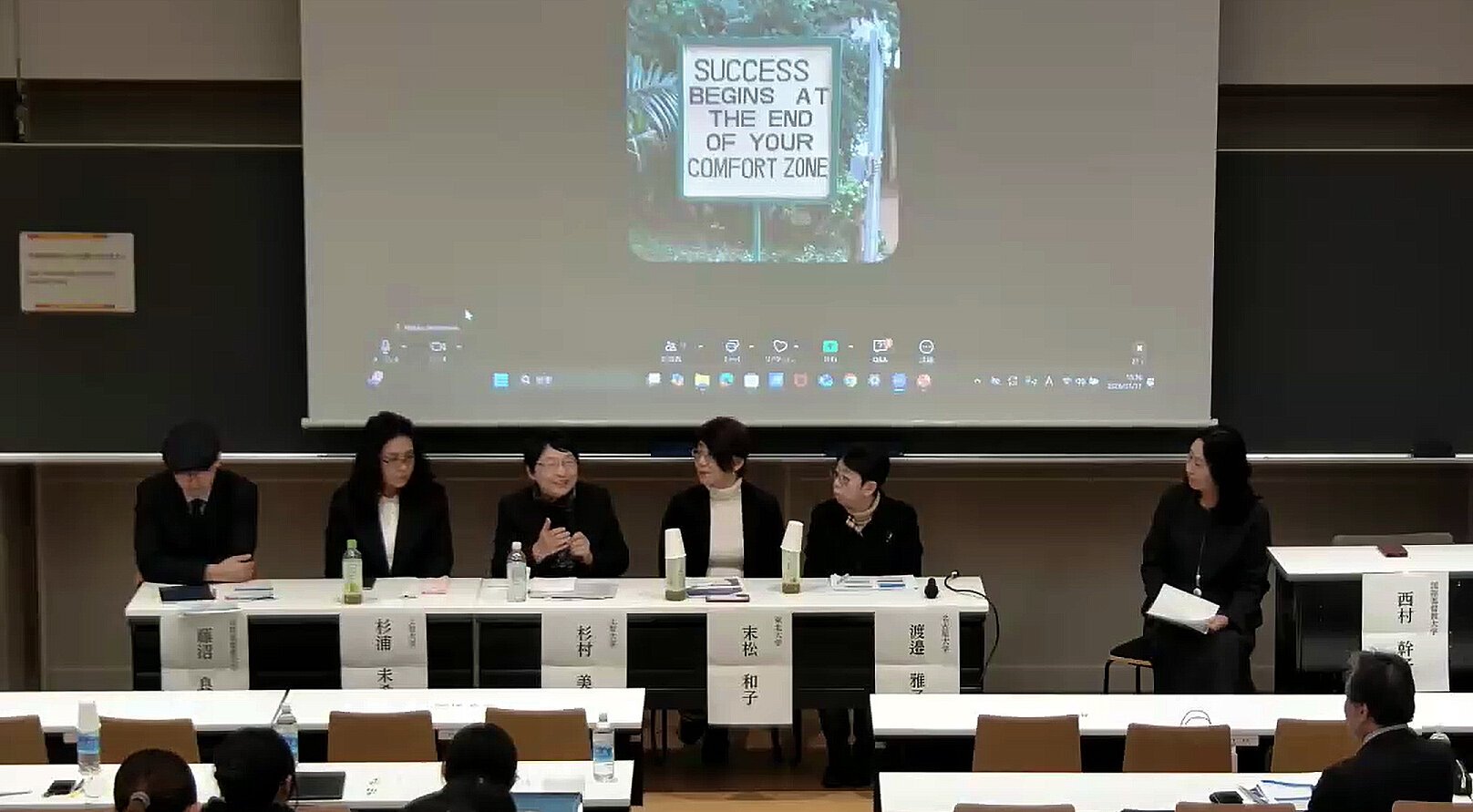
Following the two keynote speeches, a panel discussion was held by Prof. Miki Sugimura, President of Sophia University, Prof. Mikiko Sugiura of the Center for Global Education of Sophia University, and Prof. Ryosuke Fujinuma of International Christian University. The moderator was Prof. Mikiko Nishimura of International Christian University.
First, based on the keynote speech and the empirical research conducted by the two universities through the OECD project, there was a discussion on key points for realizing deep international learning. Professor Fujinuma pointed out the importance of opportunities for students to reflect and personally confirm their developed abilities. Additionally, Prof. Sugiura shared empirical research results showing that discussing with diverse others allows students to relativize themselves, discover 'connections' with others, and deepens learning. President Sugimura noted that in groups of students with diverse cultural backgrounds, fundamental and profound questions that challenge the meaning of education and the systems themselves can arise, highlighting the importance of creating teaching methods and learning environments where both students and faculty can question what is taken for granted.
There was also a discussion on what transformations are required for higher education in the future. Professor Watanabe emphasized the importance of liberal education that helps students acquire dialogue and problem-solving skills suited to various contexts by understanding diverse ways of thinking and becoming sensitive to pluralistic perspectives. Prof. Suematsu suggested that instead of viewing learning narrowly within classrooms or laboratories, a learner-centered perspective that inclusively and comprehensively considers the entire student experience, while sharing students' diverse experiential knowledge, is essential. President Sugimura pointed out that the future of higher education should prioritize 'quality over quantity' and focus on transformative education that comprehends the meaning of learning from a broad perspective, including sustainable development.
Prof. Sugiura shared an episode in which an international student described critical thinking as 'gratitude,' proposing that critical thinking is a process of understanding oneself and emphasizing the importance of sharing spaces where deep thinking is connected to oneself. Prof, Fujinuma stated that the key to enhancing creative learning lies in ensuring learning processes that challenge taken-for-granted ideas rather than focusing on correct answers based on systematic or technical knowledge, and in providing opportunities for students to present their thoughts in a way that can be communicated to others.
From the audience of over 100 participants, various challenges in teaching students from diverse cultural backgrounds and issues that may arise if experiential learning methods are institutionalized were shared. There was active discussion on ways to overcome these challenges and the versatility of pluralistic thinking.
Finally, in the closing remarks by Prof. Miki Sugimura, President of Sophia University, the importance of the symposium's agenda--reflecting on past research and further developing abilities such as creativity and critical thinking in an international and interdisciplinary context--was emphasized. Together with the keynote speakers, panelists, and participants who gathered for this symposium, there was a call to continue pursuing ideals even in uncertain times. A common theme in the discussions at this symposium was that international collaborative learning and reflection in higher education can influence learners' agency, foster self-discovery, self-efficacy, self-relativization, and the mitigation of cultural friction (accepting differences with understanding) through sharing experiential knowledge and acquiring plural thinking styles. It was also noted that the continuous sharing of intentions to connect diversity to inclusivity, along with visualizing its impact, helps cultivate institutional culture in universities. Meaningful interactions among diverse individuals, including extracurricular activities in higher education, can further lead to rediscovering one's positionality and the significance of learning at a broader societal level. It was recognized that, as a future direction for higher education, it is important to intentionally increase opportunities to engage with plural thinking styles.