NEWS
NS Forum by Professor Tokieda of Stanford University Held
Update: January 19, 2026
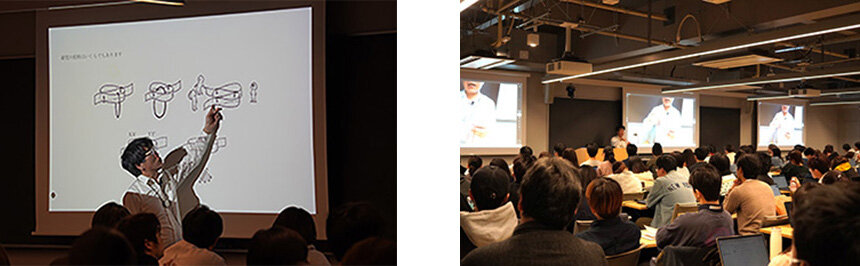
On the week of December 15, 2025, the NS forum was held over 3 sessions at the Troyer Memorial Arts and Sciences Hall, featuring Professor Tadashi Tokieda of Stanford University. The NS Forum is a seminar series hosted by the Department of Natural Sciences, introducing the latest technologies and research achievements by external researchers and engineers.
This time, lectures were given under the titles "A world from a sheet of paper," "Calculations that involve neither number nor formula," and "A magic show of pasting and cutting strips." Associate Professor Rekishu Yamazaki served as the moderator, and approximately 200 students and faculty members participated in each session, including online attendees. Students who enroll in the General Education course "N1: World of Physics (A) - Scientific Thinking" also attended the lecture.
Professor Tokieda also engages in outreach activities through platforms such as AIMS (African Institute for Mathematical Sciences) and the Youtube channel Numberphile. In the past, he even gave lectures at the International Congress of Mathematicians, held every 4 years, on two previous occasions, and plans to give one afresh in 2026.
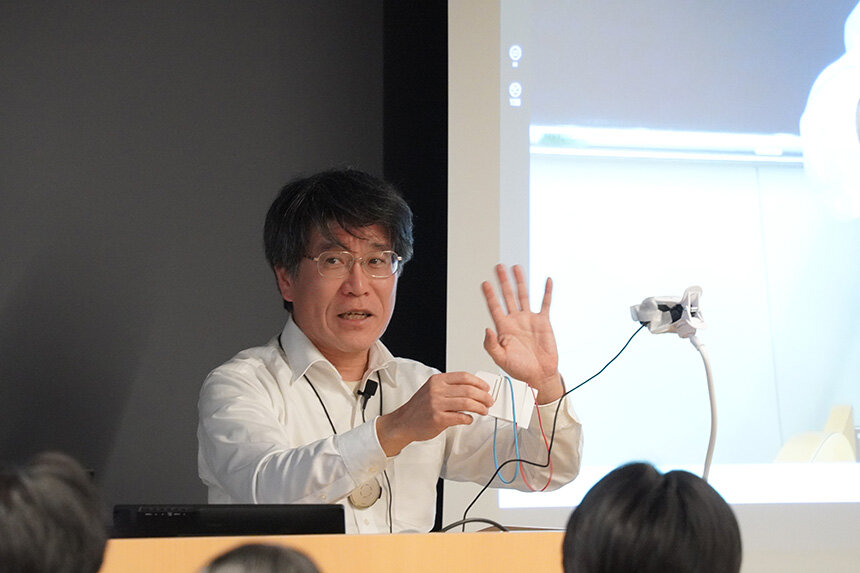
At the "Calculations that involve neither number nor formula" lecture held on December 17th, a magic show was performed using ribbon-fastened together in a S shape with two paperclips, and a rubberband hung from the ribbon. Participants were asked to predict the outcome when both ends of the ribbon were pulled slowly and then to consider why the result occurred as it did. Additionally, they examined how results differed when increasing the number of paperclips or rubberbands used to secure the ribbon, when changing their orientation, and when combining these approaches. The lecture emphasized the importance of carefully observing before and after each experiment and using those results to predict outcomes for subsequent experiments.
In connection to the show where paperclips and rubberbands were splendidly linked into short and long chains, the lecture also introduced the Borromean rings. This mysterious knot, where two rings are not intertwined yet three together form an entanglement, causes all rings to come apart if one is removed. The accident where changing a carabiner's position during rock climbing mathematically explains how the knot unravels and causes a fall was explained.
At the end of the lecture, Professor Tokieda asked, "Even though it is your first time encountering this phenomenon, how did you guess that kind of result would occur? " Professor Tokieda showcased the 3 processes that he had as below:
- 1)The research material, independent of the experimenter and the tools, is both deterministic and abstract.
- 2)Logic and the reason are pursued.
- 3)Formal patterns lead to new observations.
After that, he said that these processes are called "calculations," and the lecture came to an end.
During the Q&A session after the lecture, there was a lively exchange of views with students on topics such as teaching mathematics and the mindset of a researcher. Professor Tokieda highlighted several points: While participating in collaborative programs tackling unsolved research is necessary, discovering and nurturing the "seeds of science" outside such programs is what unlocks the beauty of science; responding to societal demands is essential for survival, but one needs not assume the current social structure is the only one; this experiment holds potential applications for calculations involving group structures; and the respective advantages and disadvantages of the decimal, binary, and duodecimal systems.
Students who participated offered the following comments:
- It wasn't a stiff lecture about the laws of physics. Instead it was an interesting lecture that uses origami and paper that are close to ourselves, which also solves hidden "why"s in our daily life. In regards to physics, its strict image was lessened a little. I felt that I should study a little more, and little by little understand the questions about physics that floods into everyday life instead of continuing to ignore them. It was lovely to catch a glimpse of a slightly more relaxing playful side of the lecturer as well.
- Throughout the lecture, I really felt the importance of what I learn from the experiments. In this day and age, people end up relying on AI for whatever they need, and I have begun to forget the importance of moving my own hands and learning through trial and error. But I felt that I cannot tackle the problems of the unknown without them.
- The Miura fold (origami) in particular left an impression on me. Up until now, I thought physics was a discipline of something like the calculation of a thing that cannot be seen. Not just the Miura fold, but through Professor Tokieda's lecture, I was able to feel that physics is something that you can indeed see.
- Through this week's class, I really felt that just cramming knowledge at the desk is not what learning is. By watching the professor actually using paper to perform an experiment, I strongly felt that visualizing the lesson and trying it ourselves is what learning truly is, not limited to physics.
- For me, as someone whose strong suit isn't physics, I was a little on guard for a lecture that someone like me can really understand. However, the professor's lecture allowed us to visualize the problems and understand them as he actually put the physics into practice in front of us. With this kind of process as the structure of the lecture, it was a very interesting and fun time. Even I, who is shaky when it comes to physics, felt that it was a very valuable lecture that taught me that inside of me, there is a door to mathematics.
- By listening to Professor Tokieda's lecture, watching the magic show, and experiencing mathematics with my hands, I realized that mathematics is essentially a fun thing. I've taken a large number of math classes, but I tend to focus on if I understand the content or if my calculations are correct. While that is important, through Professor Tokieda, I realized a flash of interest for mathematics, and how fun things like math and physics are. For example, the final lecture showed that the mathematics could be understood from one piece of paper strip. I realized that mathematics wasn't a listing of strict formulas, but it was fun that could be found from the laws of nature in papers and clips. I was deeply impressed that the essence of mathematics and the laws of nature is something that one can use to cut open the secrets of the world.
- I listened to all 3 of the lectures and came to like mathematics. When I was in high school, I selected a curriculum that did not require me to take natural science subjects. I didn't really like mathematics and didn't really understand what to do with mathematics and what for. However, Professor Tokieda's lecture explained natural phenomena through mathematics, which made me realize that mathematics is a tool to unravel the natural phenomena of this world. This was the first time that I felt mathematics was interesting. When I had lunch next to the professor, we had an extremely interesting conversation on the topics such as hallucination, and I was extremely happy. In addition, he sincerely answered my question about the difference between being strong in a subject and liking the subject. His answer "mathematics is different from music, it goes from being strong to something you like," is something that is engraved deep in my memory.
The valuable lecture made us discover what calculations are in the first place and that, even without manipulating numbers and formulas, full calculations are possible.