

NEWS
2026 Spring Commencement Ceremony was held
Update: March 24, 2026
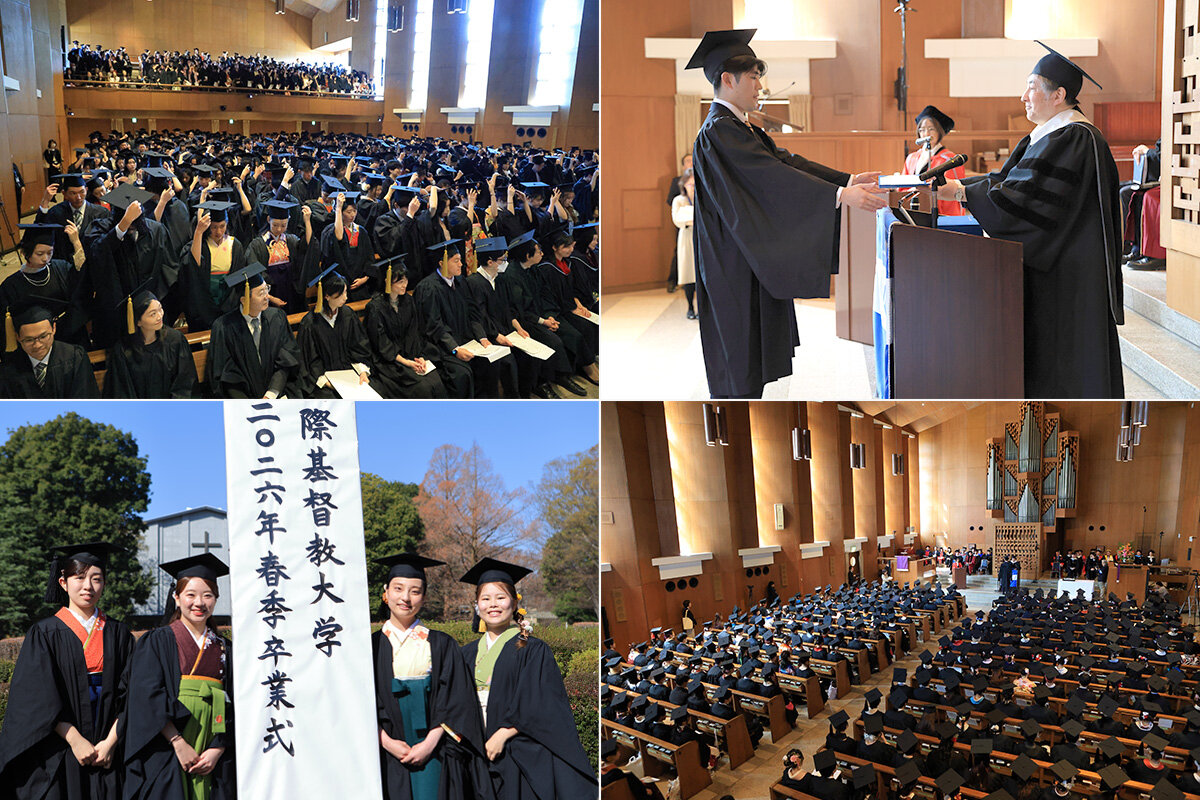
On March 24, 2026, 543 undergraduate students and 53 graduate students graduated from ICU at its Spring Commencement Ceremony held at the University Chapel.
At the ceremony, each student's name was read out in keeping with tradition that has continued since the first commencement ceremony. Also, students sang hymn together and listened to the scripture reading and President's commencement address.
After the ceremony, students cheerfully greeted their schoolmates and family at various places on the calm campus where the arrival of spring can be felt.
Scripture Reading
First Corinthians 13: 1-3 by Hiroyuki Kose (Chair, Religious Affairs Committe)
Commencement Address by Shoichiro Iwakiri, President
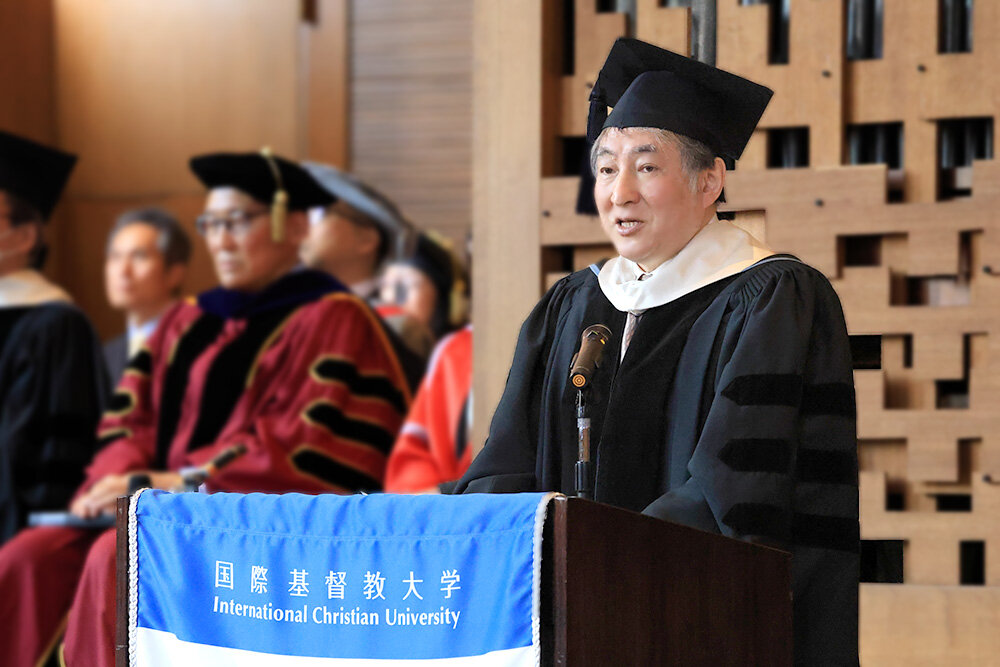
Congratulations to all who have completed your Bachelor of Arts program in our Division of Arts and Sciences as well as to those who have finished the MA or PhD programs in our Graduate School of Arts and Sciences and who are graduating today. I also offer my sincere congratulations to all family members, relatives and friends of our graduates.
Today, as you graduate from ICU, each of you takes a first step on a new path. It is only natural that your hearts are filled with a mixture of anxiety and hope about where that step might lead.
We cannot know in advance what lies ahead in the lives we lead. There are many things in life that simply cannot be understood until they are experienced. You will encounter not only joy and excitement, but also pain and sorrow. Indeed, it is irresponsible to offer the empty consolation that "hardships will eventually become fond memories."
What I can say, however, is this: as you walk your own path, I want each of you to be someone who continues to reflect on the meaning of that journey and your own experiences.
Within the time granted to you—from birth until death—you must think about what has happened, what it meant, and give those experiences your own form of expression. Then, using that as a starting point, you should remain conscious of and articulate in your own words what is happening in the broader social context that made your individual life possible.
I believe that through your liberal arts education, you have cultivated the fundamental abilities necessary to do exactly that.
In addition to cultivating the power to think and the power to give form to those thoughts, I believe that you have, in fact, also acquired another ability.
As your skills for expression become more grounded within you, things that cannot be captured by that power—things that seem impossible to put into words—gradually begin to reveal themselves. You become aware that, within yourself as you speak, or within this world of constant, talkative exchange, there are things that resist language entirely; there are times when we must face that silence.
That silence begins to feel as if it is trying to express the inexpressible through something like a wordless language. It is a silence that seems to say that it refuses to be captured by ready-made words, and it often enfolds and protects something incredibly fragile.
It is also one of the essential endeavors of being human to express what such silence enfolds in unconventional ways, making it something that can be truly sensed. I believe that, through your university life, you have acquired the foundations of two distinct abilities: the capacity to analyze and articulate situations, and the sensitivity to feel what lies within silence and bring it forth as something communicable. I hope that in your life after graduation, you will continue to deepen these abilities even further.
*
In the Bible reading we just heard, we were reminded of the vital importance of love. The knowledge you have acquired through your studies and research at ICU can become hollow and noisy if it is not used with love. I must admit that I sometimes wonder if I am always able to put this into practice myself; but I would like to share my hope with you, partly as a reminder to myself. Let us live in a way where love resides within our words, our thoughts, and our actions.
*
In my speech at last year's commencement ceremony, I said the following:
And the world seems to be heading down the path of increasing domination by force, with state selfishness to the fore, rather than along the path of prosperity by balancing competition and coexistence in an attempt to alleviate
One year later, persistent dialogue and negotiation centered on international cooperation have receded even further into the shadows. Those who hold military superiority now brandish naked desire, continuing to destroy the lives of people in nations they have deemed enemies.
The human happiness that war destroys is inextricably linked to other vital concerns: the natural environment, devastated by excessive development to satisfy human greed; and human dignity, neglected through the unequal distribution of wealth, social disparity, and exploitation.
Our university was founded specifically to nurture individuals who will resist such destruction and social injustice.
Recently, I attended a concert featuring a contemporary piece (composed by Masakazu Natsuda) performed by an ensemble of Western early instruments and Japanese gagaku instruments. The ensemble is managed by an ICU alumna.
The concept of the piece is that every single day is an irreplaceable and precious one. During the performance, several poems were recited, and in the session I attended, Hiroshi Osada's poem "What is Indispensable" (Nakute wa naranai mono) was selected. It contains the following passage:
To exist in this world is a poignant thing.
And precisely because of that, those who seek war
fear, above all else, the tranquility of the everyday.
Peace is a single (most ordinary) day.
If we truly love the "tranquility of the everyday," no one would ever think to follow those who seek war. Within these tranquil days, there is a sense of joy--and the poet tells us that this joy belongs to no one in particular; it is simply something common and ordinary. Osada also says:
It is not possession that creates the joy of our days.
Grass. Water. Soil. Rain. Sunlight. A cat.
A stone. A frog. A lily. The blueness of the sky. The distance of a road.
Not a single thing belongs to me.
The stillness of an afternoon on a day of crystal-clear air.
The shimmer on a river's surface. Thick foliage. The shape of a tree.
Evening clouds. The shadow of a bird. The twinkle of the evening star.
There is nothing special. There are only
(ordinary) things I want to cherish.
The most wonderful things are those that belong to no one.
War is triggered by the desire to seize and possess something from another--most often territory or resources. When we lose the sensitivity to find joy in the simple act of coexisting with "things that belong to no one" and "things that are ordinary," that may be the very moment we begin to collude with war.
To believe that a single day is irreplaceable we need peace. And that irreplaceability is something that can never be expressed in numbers.
Grass. Water. Soil. Rain. Sunlight. A cat.
We see them every day on the ICU campus. In the evening, looking up at the trees and the sky from the bus stop, there are over a hundred crows; it feels somewhat eerie, and I am not entirely sure if they are creating "joy" or not. Yet, including even that, I believe the nature on the campus has been speaking to you about the importance of "ordinary things." At the same time, you know all too well that for those things to remain "ordinary," they must be consciously and deliberately maintained.
*
The joy of our daily lives is built not only from the scenes of nature, but also from the delight of discovering new things, the pleasure of sharing thoughts with others, and the fulfillment of achieving something together.
I pray that your lives ahead will be filled with the grace of God, with abundant happiness and with the joy of every day. Take the experiences you gained here at ICU as nourishment for your soul, and spread your wings wide.
Congratulations on your graduation.