

NEWS
2026 Spring Matriculation Ceremony
Update: April 2, 2026
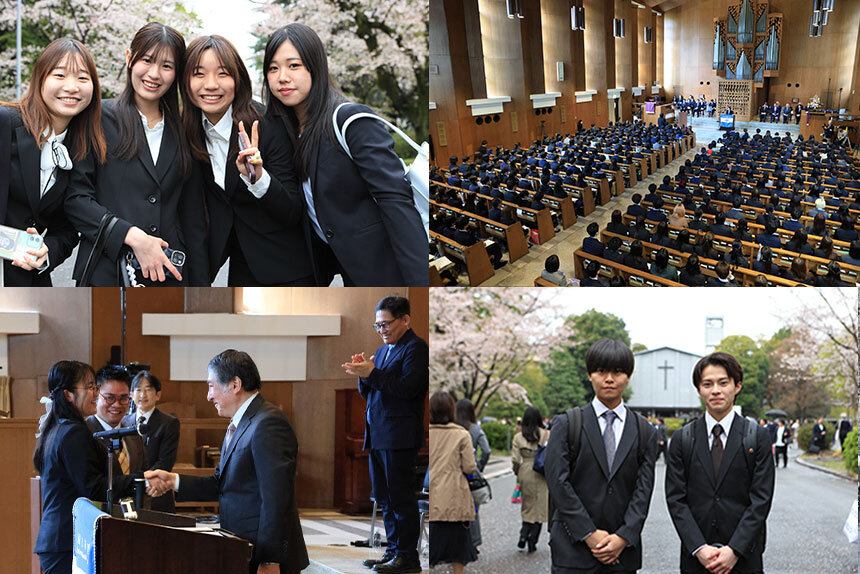
On Thursday, April 2, as the cherry blossom petals drift through MacLean Avenue, ICU welcomed a total of 716 new undergraduate and graduate students from within and outside Japan at the Matriculation ceremony held in the University Chapel.
As per the tradition that has been followed for over 70 years since the founding of the University in 1953, the students' names were announced individually and all new students signed the written pledge to uphold the principles of the Universal Declaration of Human Rights in their student lives.
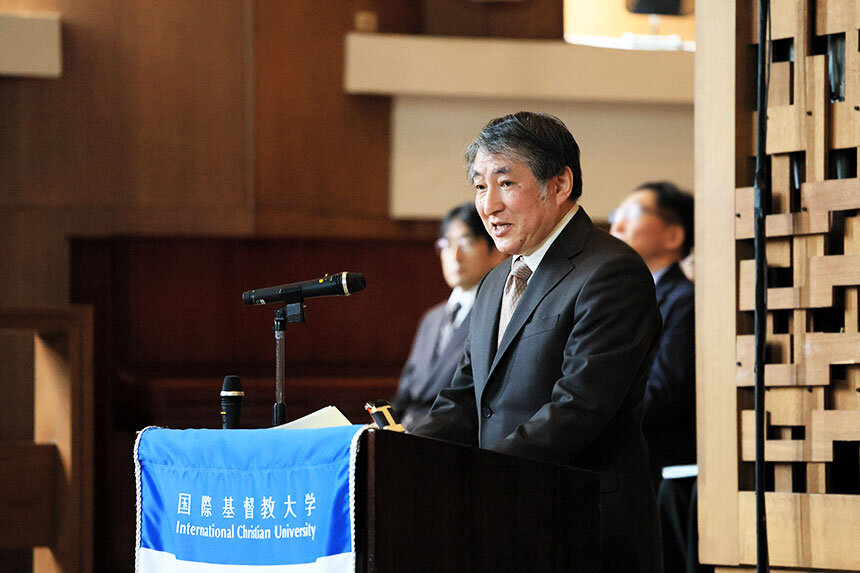
President Shoichiro Iwakiri gave a welcome speech to the newly gathered new students.
Scripture Reading
Second Corinthians 4:18 by Saran Shirozawa(Religious Affairs Committee)
2026 Spring Matriculation Address by Shoichiro Iwakiri, President
A warm welcome to all of you who are entering our College of Liberal Arts and our MA and PhD programs. At the same time, I extend my warmest regards to all your family members and friends who are joining us online.
The kanji for "spring" (春) is said to depict the appearance of grass budding under the warmth of the sun. The Japanese word haru evokes the swelling of buds and the awakening of all living things. In English, "Spring" suggests the vivid surging of water and the pulse of life. The French le printemps and Italian la primavera both contain the meaning of "the first." Spring is the season of beginnings. Three days from now, the Christian world will celebrate Easter—the resurrection of Jesus Christ, who is Life itself, from death.
On this spring day overflowing with life, your studies and research at ICU begin. I imagine many of you are filled with a variety of expectations, dreams, and visions for your student life here at ICU. At this moment, those represent an ICU of your imagination. From today, you will experience the reality of ICU, and years from now, a "substantial" ICU will have been constructed within you. It is my hope that, through a liberal arts education and meaningful human relationships, a rich and unique harvest will be brought forth in your lives.
University education is referred to as 'higher education.' In French, it is called l'éducation supérieure. Both terms carry the connotation of a "loftier" level of education. Whether you are an undergraduate or a graduate student, in the classes beginning next week, you will enjoy a level of education one step above anything you have received before.
Many of you have just completed your high school studies. The knowledge gained in high school is vital; it forms the foundation for university learning. However, that knowledge is often a collection of "already known" facts. Until now, your learning may have primarily consisted of seeing what was meant to be seen and hearing what was meant to be heard.
In higher education, it remains important to accumulate knowledge that is known to experts but new to you as a beginner. Yet, university learning is more than that. What is even more crucial is to discover, make visible, and bring into consciousness that which is not well known, not seen, or not noticed—both by yourself and by others. To bring to light hidden social structures, unconscious psychological frameworks, and the unraveled truths of natural science, and to share them as collective knowledge; this is the endeavor of university learning.
This corresponds to the "Science" portion of "Arts and Sciences" at ICU.
As I have said repeatedly on various occasions, the "science" I refer to here includes the social sciences and humanities, not just the so-called natural sciences or engineering. As is well known, the etymology of "science" is the Latin word scio, meaning "I know"—in essence, knowledge. Before dividing systems of knowledge into categories used in Japan like "literary" or "scientific," "science" exists at the root of all academic disciplines. All learning at a university is "science." Starting from there, our intellectual curiosity leads us to various specialized fields, each with its own characteristic theories and analytical methods.
Because newly discovered things are new, they are not yet shared by society at large. The skill required to transform these discoveries into a form that can be shared with others is the "Art" in "Arts and Sciences." It is the skill necessary to carry the "unknown" into the realm of "knowledge." In that sense, writing a thesis is also a practice of "Art".
*
In a letter written on May 15, 1871, at the age of sixteen, the 19th-century French poet Arthur Rimbaud stated that what matters for poetry is to "scrutinize the invisible" and "hear the unheard."
The English word "poetry" and the French poésie derive from the Greek poiein, which originally meant "to make" or "to create." In modern Japan, rather than being highly esteemed as creators of new worlds or new sensibilities, poets are sometimes mocked as "poemers"—people who indulge in self-centered fantasies and say embarrassing things. However, the ability to see the invisible and hear the inaudible is a poetic capacity. It is a vital quality in the academic world, where we create new concepts, perspectives, and materials for human society.
In the Bible reading we heard earlier, there was a contrast between the "visible" and the "invisible." University learning and research possess a duality: they target the visible, material world of phenomena while remaining open to the perception of the invisible things that lie behind it. If the purpose of study were merely to acquire skills to navigate the material world successfully, then university learning might prioritize "cost-performance" or "time-performance."
But learning at ICU is different. It is an intellectual endeavor that takes time and possesses a sensory depth—unlike the efficiency of AI, which provides immediate answers to questions. At ICU, learning happens through daily dialogue and critical thinking, as we contemplate ways to improve the world and search for the meaning of existence and life—questions for which there are no ready-made answers.
*
ICU was founded 73 years ago. Its purpose was to cultivate people who contribute to the establishment of peace through a liberal arts education. Wars continue in the world today. Those who seek peace are those who love a tranquil daily life. However, as long as our seemingly peaceful lives are supported by the benefits of modern industry and technology, we are not entirely severed from the destruction of the environment or complicity in war. Within this global context, let us continue to ask—through liberal arts learning and research—what values and visions we will carry as we move toward the future.
Amidst the rich natural environment and human relationships of ICU, I hope that you will encounter the unknown and practice the creative learning and research that transforms it into something intellectually understood.
Congratulations on your admission to ICU.