

NEWS
ICU Founder's Day Commemorative Service
Update: June 11, 2026
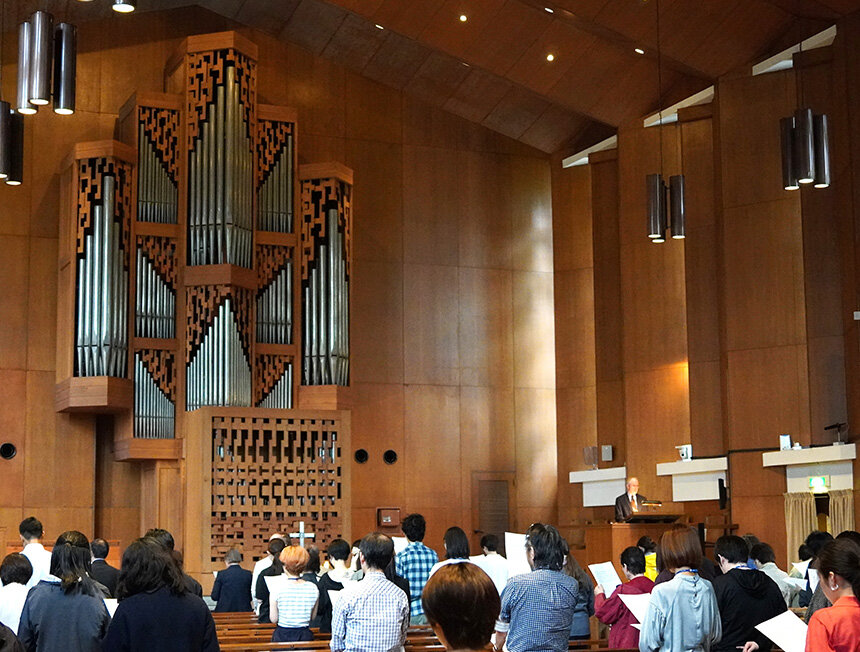
A service to commemorate ICU's founding was held at the University Chapel on June 9 during chapel hour.
The service is held every year in remembrance of the day when the university was officially established at a meeting of the organizing council of Japanese and North American Christian leaders who gathered at YMCA Tozan-so in Gotemba, Shizuoka Prefecture, on June 15, 1949 (Gotemba Conference). On the same day, the Board of Councilors and the Board of Trustees were inaugurated, and the founding principles as well as a fundamental education plan were laid down.
At the service presided over by Acting Director of Religious Center, Professor Jeremiah Alberg, Hymn "Faith of Our Fathers!" was sung and Matthew 5:3-11 was read. President Shoichiro Iwakiri delivered a message titled "The Founders".
Message by Shoichiro Iwakiri, President
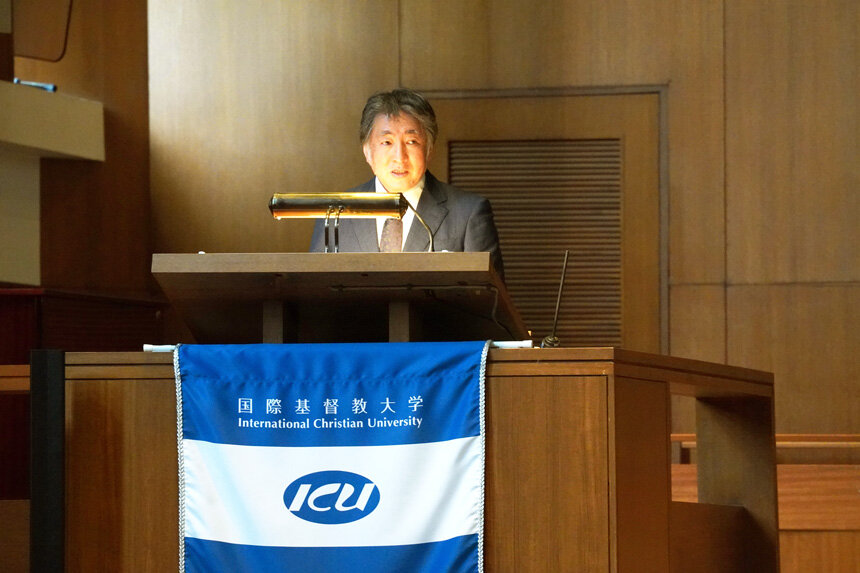
The official date of ICU Founders' Day is June 15, but we traditionally commemorate the occasion during chapel hour, as we are doing today.
The theme guiding chapel hour this year is "Knowing Jesus." In the same spirit that seeks to understand those who shape our lives, we might ask: Who were the founders of ICU? Many names come to mind, such as Reverend John MacLean who issued the first call in the United States to establish ICU, and our founding President Hachiro Yuasa. If we could step back to June 1949 and pose to those at the Gotemba Conference — where the decision to establish the University was made — the question, "Are you the founders?" they would probably shake their heads and tell us that the real founder was Jesus Christ, on whose behalf they worked.
We offer our gratitude to Jesus Christ, the Founder of our university, and to all those before us who devoted their lives to His work.
Our founding mission has been faithfully passed down for 77 years since the University's establishment in 1949, and 73 years since the first matriculation ceremony in 1953. Power of Connection was the theme of the Homecoming event held last month. As we forge bonds across generations, ICU continues to evolve and flourish.
As a testament to the legacy carried through generations and enduring unity of our community, we have new landmarks such as the Troyer Memorial Arts and Sciences Hall, named in memory of the First Vice President Dr. Maurice Troyer. He was present at the Gotemba Conference held in June 1949, counted among the very founders.
It is my honor today to announce that Maurice and Arvilla Troyer's granddaughter Kate Baldor and her niece Jessamyn Rising are among us today. May I invite our honored guests to stand and be recognized? It's our great joy to welcome you at ICU in this Founders' Day Chapel Hour. We are also grateful to you for your love of ICU and we would like to express our gratitude for your generous donation. Thank you very much.
Today we are celebrating an event of the past, yet it was never merely a point in history. It endures within us, embodied in those shaped by it and passed onward from generation to generation as time advances. This is a bond I wish to cherish.
Two weeks ago, I had the opportunity to deliver a lecture at the Peace-preneur Forum in Nagasaki, where I explored the theme of dialogue from the standpoint of literature and the liberal arts.
Dialogue lies at the heart of the liberal arts, echoing a Western theatrical tradition that began in ancient Greece in the 6th century B.C. Thespis, the earliest tragedian, is said to have introduced a performer who could speak lines apart from the chorus, transforming choral performance into a dramatic art form and inaugurating true dramatic dialogue.
As someone outside the field of Western classics, I asked Professor Yoshinori Sano to review my Forum lecture. I had assumed Thespis was also an actor, but he noted that while Thespis may not have been an actor himself, it would be more prudent to say he created the role of the actor. Moments like this remind me how valuable it is to consult a specialist.
While dialogue first entered theatrical performance in ancient Greece, Plato began shaping Socratic philosophy in the form of dialogue in the 5th century B.C. Socrates pursued his love of knowledge through conversation, yet — as you know — he was ultimately charged with corrupting the youth and condemned to death for impiety by disbelieving the city's gods and invoking a personal daimōn. In renewing my wonder at how the practitioner of dialogue— the very cornerstone of liberal arts— could have met such an end, I returned to the Apology, Crito, and Phaedo — texts I had not opened in many years.
What struck me was that Socrates' opponents were driven largely by concerns about their own self-esteem. By exposing the limits of their knowledge, he stripped away the confidence of those who thought themselves wise.(Apology) He explains that people resent him because he reveals that they do not, in fact, know what they claim to know. To assert knowledge without possessing it is, in his view, like sleeping in front of the truth. His questioning served as a wake-up call, which is why he compares himself to a gadfly that keeps the great horse awake. (Apology 30e) He notes that people react to him as if they were being shaken awake just as they are drifting off. (Ibid., 31a)
Words that awaken you are welcomed by those who know they do not know, as they are stirred and delighted to gain new understanding. But those who rely on their self-esteem for a sense of certainty react with irritation, because such words unsettle the very foundation of their self-image.
I think ICU was able to cultivate a dialogue-centered liberal arts tradition from its founding because it never assumed a posture of superiority. Rather, it engaged others with the humility of being "poor in spirit." (Matthew 5:3: Blessed are the poor in spirit)
Dialogue has a puzzling quality. I noticed this when reading Crito. When two people enter into dialogue, they do so from different perspectives. Yet the very act of talking signals a search for common ground. If two individuals were identical in every respect, they would be mere clones of one another, and any exchange between them would collapse into a monologue. Conversely, if they shared nothing at all, dialogue would break down entirely and only conflict would remain.
I have learned it's valuable to pause and recognize where we agree during a conversation.
What we share may be, for instance, the insight that the aim is not simply to live but to live well. (Crito 48b) Even if both people accept this, they may disagree about what "living well" actually means--and that disagreement becomes the starting point of the conversation. Without at least some common ground, though, no dialogue can begin at all.
Today, wrongdoing often provokes more wrongdoing — rarely with apology. Socrates was not addressing our moment specifically, but his point was timeless: responding to wrongdoing with more wrongdoing never makes it right. But at the same time, he also says:
Only a small number of people think in this way, and it will remain so in the future. Hence, those who hold such views and those who do not cannot reach a common understanding; they will inevitably despise each other's proposals. (Crito 49d)
I had not given much thought to his cynical side before.
Although we don't need to interpret everything through the lens of our own moment, the liberal arts in a sense embodies this "small number," this gadfly that rouses the sleeping horse, serving as a deliberate wake-up call.
Why intentionally disturb people asleep in the sweet dream of self-esteem? Because waking to genuine understanding purifies the soul, at least when the knowledge gained is meaningful. Real knowledge humbles us.
At the root of the liberal arts ICU has practiced since its founding, is what Socrates called a life dedicated to the love and search for wisdom (Apology 28e), joined with the Christian ideals of humility and love of neighbor.
Amidst the difficulties and absurdities of the times, we shall carry out our founding mission, grounded in liberal arts and Christianity, renewing ourselves every day and fostering a campus where genuine dialogue can flourish.