

NEWS
2026 Summer Commencement Ceremony
Update: July 15, 2026
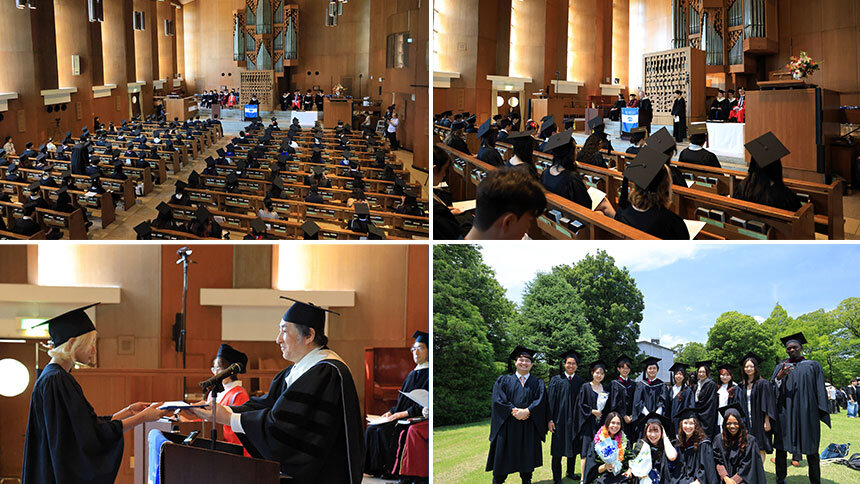
On July 14, 111 undergraduate students and 42 graduate students graduated from ICU at its summer commencement ceremony held at the University Chapel on July 14.
At the ceremony, each student's name was read out in keeping with tradition that has continued since the first commencement ceremony. Also, students sang hymn together and listened to the scripture reading and President's commencement address.
Also during the ceremony, the title of Professor Emeritus was conferred to Professor Toshiaki Sasao, with effect from April 1, 2026.
Graduates reflected on their university days, spending time with friends and family on campus.
Scripture Reading
First Corinthians 13 : 1-3 by Saran Shiroza (Religious Affairs Committee)
Commencement Address by Shoichiro Iwakiri, President
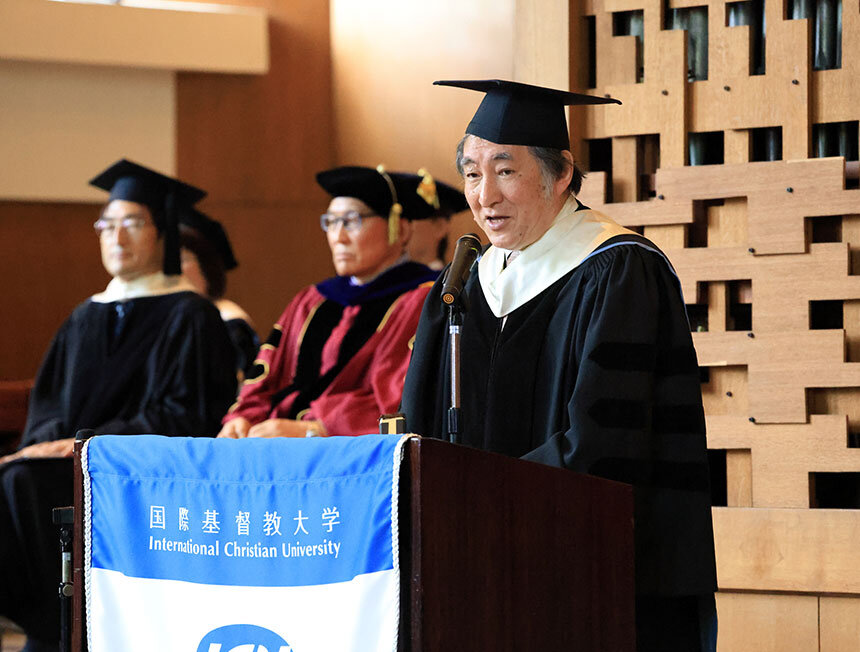
Congratulations to all who have completed your Bachelor of Arts program in our Division of Arts and Sciences, as well as to those who have finished the MA or PhD programs in our Graduate School of Arts and Sciences and who are graduating today. I also offer my sincere congratulations to all family members, relatives, and friends of our graduates.
During the past few years that you have spent studying and conducting research since entering ICU, the learning environment has undergone dramatic changes, driven particularly by the evolutionary rise of AI.
I remember the very first time I asked ChatGPT a question. It was in 2023.
Today, when I ask something, an answer appears instantly.
Back then, however, when I typed a query in Japanese, a small black square blinked on the screen, and then that square glided across the screen, laying out characters as it moved. Sometimes, it paused, taking a moment as if it were deep in thought. Looking back, it feels quite pastoral.
In 2023, I asked ChatGPT: "Who are you?" It replied that it was a large language model called ChatGPT, based on the GPT-3.5 architecture.
Looking it up on the internet now, we can find that the GPT-3.5 architecture was an evolution from GPT-3. It represented the stage where AI transitioned from simply predicting the next words to understanding user intent and becoming a helpful assistant.
I then asked ChatGPT, "What is the happiest thing that has ever happened to you?" ChatGPT answered like this: "Because I am an AI, I do not possess emotions. Since I cannot experience emotions or have personal experiences, I do not have happy experiences. I am strictly a tool designed to provide information and support. What other questions can I answer for you?"
It was certainly pre-programmed to respond that way, and it did not fabricate a "happiest moment" by inventing a life story; instead, it confessed, "I do not possess emotions." I felt a sudden sense of familiarity with it, thinking how remarkably honest its answer was.
Through this personal anecdote, I came to realize something which is, in itself, quite obvious: although words were exchanged between the AI and me in a way that looks like a dialogue, and the AI can even refer to itself using the first person 'I', it does not possess a personality. Therefore, it cannot be an agent that takes responsibility for the words it utters.
Artificial intelligence has continued to evolve at a staggering pace. Some experts even predict that the moment of so-called "singularity" is fast approaching — a point where artificial intelligence surpasses human intelligence, triggering technological transformations that exceed human comprehension and foresight.
Faced with these profound technological changes at your graduation, society — or rather, people in industry and educational administration — frequently demand that you should "cultivate the ability to adapt to an unpredictable future."
Because a liberal arts education nurtures the capacity for flexible, independent thinking to tackle problems for which no answers are predetermined, I believe you have nothing to worry about when it comes to the adaptability required by future society. However, I also believe that you yourselves do not think that acquiring this ability was the sole purpose of your ICU education.At ICU, both the undergraduate and graduate schools are providing education under the name of "Arts and Sciences." Science, by its very nature, finds its meaning in knowing something new. Therefore, whether it is the humanities, social sciences, or natural sciences, its fundamental role is to use the power of reason to translate things that currently exceed human understanding and prediction, or things that are yet unknown, into matters that humans can comprehend.
Yet, if science were to rely solely on reasoning and constructing logic, the activities sustained by human intelligence might one day be entirely replaced by those performed by artificial intelligence. On a physical level, human technology has always functioned this way: machines do what human power cannot. We live in an era where this potential is expanding beyond the physical domain and into the domain of intelligence.
The message I wish to share with all of you graduating today is that while intelligence may indeed become artificial, humans possess a capacity called the intellect, which can never become artificial. This is a capacity closely tied to wisdom (sapientia). It is not concerned with things that "exceed human understanding or prediction" in a technological or rational sense. Rather, it is the capacity to recognize transcendence--to be open to that which surpasses ontologically human understanding. As a Christian university, ICU perceives this transcendence in God. It involves loving others in ways that we, as human beings, could never predict, intuiting the nature of existence, and seeking happiness of mind.
You have developed an intellectual attitude to utilize AI as a tool with capabilities beyond human intelligence, and you have acquired academic knowledge. At the same time, through your days at ICU, you have deepened your experience of the world — something AI can never possess — which is perceived through emotions and senses, and is deeply personal yet shareable with others. Every one of us lives as a being with our own personality.
Through these experiences, I believe you have felt yourselves becoming free. The most vital function of the liberal arts is to set people free. That freedom is brought about by knowing the diversity of humanity and nature. It is brought about by the expectation that you understand the world more deeply today than you did yesterday, and that you will understand it even more deeply tomorrow. Furthermore, freedom comes when we discover the truth about others through dialogue, liberating ourselves from our own narrow views. That freedom is brought about by loving our neighbor, just as God loves humanity.
During the few years you have spent studying and researching at ICU, the world has drifted further away from peaceful coexistence, showing a stronger inclination toward dominance through armed force. Divisions within society are widening, and the natural environment is being destroyed for the sake of human convenience, plunging the world into an increasingly critical state.
We must transform this world into one that is truly fit for humans to live in. It is my sincere hope that each of you, in your respective places in life, will actively work to build a better world. Guided by the science and arts you mastered at ICU, the friendships you forged here, your will for peace, and human trust and love open to God, may you create your life on this foundation and walk a fulfilling path ahead.
Congratulations on your graduation.
Professor Emeritus
Professor Toshiaki Sasao joined ICU in 1997 and served the university as a full-time faculty member until 2021, followed by service as a Professor by Special Appointment until 2024. During his years at ICU, he devoted himself to teaching and research and made significant contributions to the advancement of the university's academic and educational activities.
He also served in a number of leadership roles, including Director of Faculty Development, Director of the Peace Research Institute, Coordinator of the American Studies and Peace Studies Programs, and Chair of the Department of Education and Language Education, contributing greatly to the development of education, research, and university administration at ICU.