

NEWS
2026 Autumn Matriculation Ceremony
Update: September 3, 2026
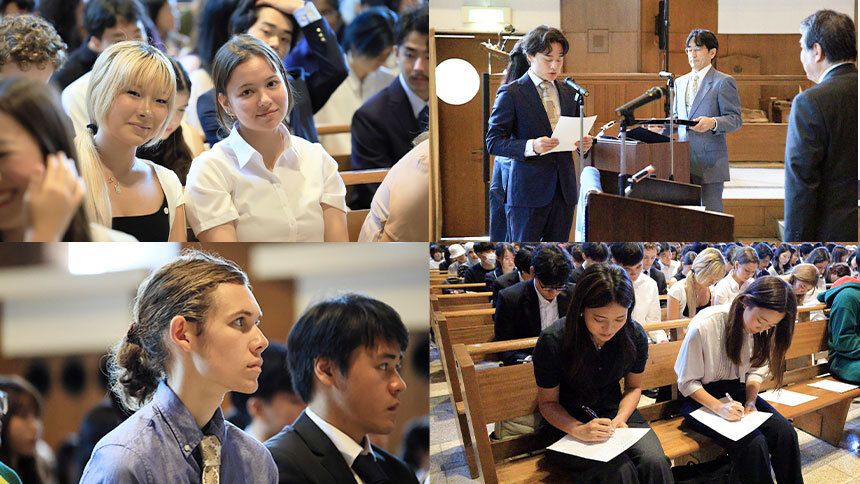
On September 1, ICU welcomed over 312 new undergraduate and graduate students including those graduating from high schools abroad, international schools in Japan, and exchange students from partner universities, at the Matriculation Ceremony held in the University Chapel.
The Ceremony started with a hymn and prayer by Jeremiah L. Alberg, Acting Director of the Religious Center. Next, Stephen Edward Eskildsen, Chair of the Religious Affairs Committee read Matthew 13:3-8.
As per the tradition that has been followed for over 70 years since the founding of the University in 1953, the students' names were announced individually and all new students signed the written pledge to uphold the principles of the Universal Declaration of Human Rights in their student lives.
President Shoichiro Iwakiri gave words of encouragement to the newly gathered new students.
2026 Autumn Matriculation Address by Shoichiro Iwakiri, President
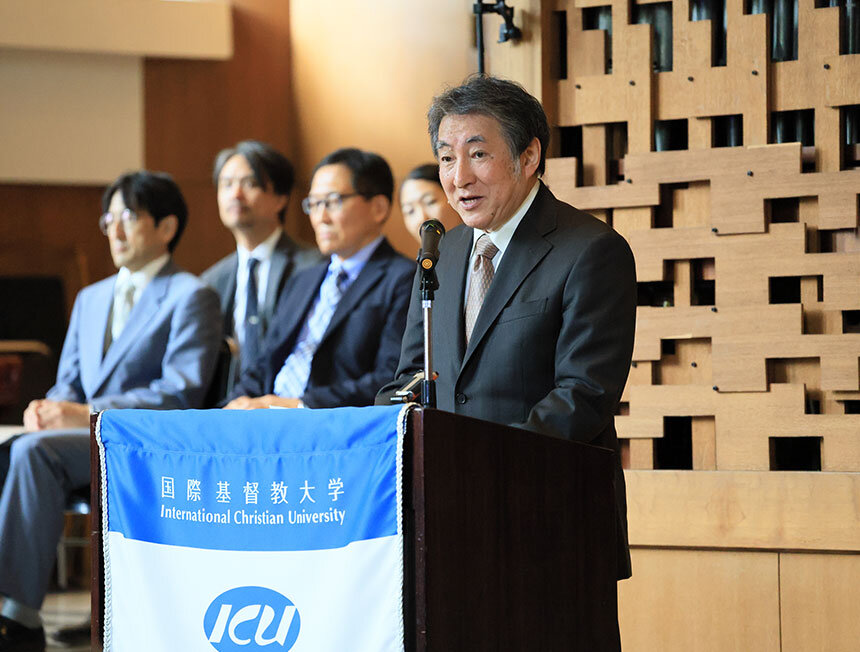
A warm welcome to all of you who are entering our College of Liberal Arts and our MA and PhD programs. At the same time, I extend my warmest regards to all your family members and friends who are joining us online.
In the 18th century, during the Age of Enlightenment, there was a French playwright named Beaumarchais. Some of you may enjoy Mozart's opera 'The Marriage of Figaro' or Rossini's 'The Barber of Seville; Beaumarchais wrote the original plays upon which these operas are based.
He wrote in his essay on drama: "I leave the theater a better person than when I entered" ( "Je sors du spectacle meilleur que je n'y suis entré"). As a writer of the Enlightenment, he believed in human progress. On the stage, it is true that under the eyes of the audience, misfortunes and absurdities are represented, but a drama can let us consider human truths and the underlying causes of what happens in life and in society. We can also have a vision of happiness and, through emotions we feel, we can fortify our reason and become better individuals.
The notion of self-improvement was by no means confined to the Enlightenment era. Even in ancient Greece, Socrates says in one of Plato's works that' the essential thing is not living, but living well.'
You have newly matriculated into International Christian University. While it may seem odd to contemplate your departure at the very moment of your arrival, I hope that, much like Beaumarchais leaving the theater a better person than when he entered, you will become better human beings through your academic activities at ICU. And as Socrates advocated, rather than simply living — or in the context of academic life, merely studying or acquiring technical skills — may your learning serve to enrich your soul, grounded in a genuine love for wisdom.
The liberal arts education in which you are about to engage represents precisely this tradition. I ask that you hold fast to the pursuit of living well and becoming better individuals. As on the stage, the issues you will confront in your coursework and thesis writing will not always be merry or comfortable. Indeed, the opposite is more likely. In higher education, as we deliberate upon fundamental truths and conditions regarding human nature, history, society, and the natural world, we must inherently face the deep-seated conflicts and questions they include.
Since its founding, ICU's mission has been to nurture students to become international citizens, or in today's terms, global citizens, and peacebuilders. And from the outset, ICU has valued individuality, freedom, democracy, equity, dialogue, internationalism, diversity and critical thinking.
To achieve this mission, ICU fosters continuous discussions between students and faculty from diverse academic perspectives. Through this sharing of knowledge, we seek to bring into our field of perception that which has not yet been fully captured by current human knowledge — or has been obscured by knowledge itself.
We seek to deepen our comprehension of a world where freedom and happiness are compromised by violence, bondage, and the fractures that run through society and the human heart. At the same time, we seek paths toward peace and reconciliation, while exploring the beauty that sustains humanity at the deepest level of our existence.
As of today, you become members of this liberal arts community. Liberal arts education consists not only of learning in the classroom, but also of studying abroad, service-learning, student club activities, and the connections you make on campus. Through these diverse opportunities, I hope you will gain a wealth of experiences that will nourish your life.
The Scripture reading presented earlier was the parable of the sower, taken from the Gospel of Matthew. Shortly after this parable, Jesus Himself elaborates on its deeper significance — I invite you to consult the Scriptures later to reflect on it in full.
For my part, I'd like to mention its essence. Jesus teaches that we ought to become good soil. The term "good soil" signifies "someone who hears the word and understands it." For a word does not bear fruit merely by being heard, but when its meaning is truly comprehended.
Though rooted in faith, this lesson speaks directly to the nature of academic pursuit in higher education. Throughout your journey at ICU starting today, may you encounter words that take deep root, nurture those fruitful words within your lives, and harvest rich fruits in abundance.
Congratulations on your matriculation.