

NEWS
2026年秋季入学式を挙行
公開日:2026年9月3日
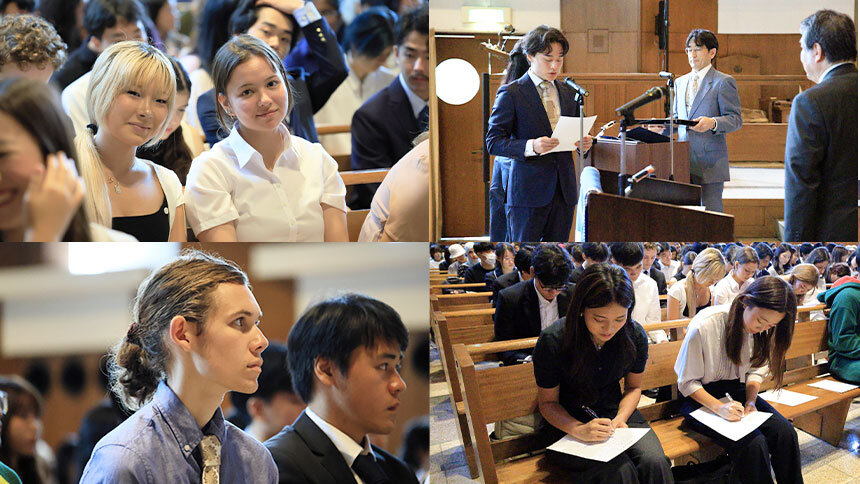
9月1日、大学礼拝堂において秋季入学式を挙行し、海外の高校や国内のインターナショナルスクールを卒業した学生をはじめ、交換留学協定校からの留学生など、学部・大学院合わせて312名の学生が本学に入学しました。
入学式は、参加者一同での讃美歌歌唱、オルバーグ, ジェレマイア L.宗務センター長代行の祈祷で始まりました。続いて、エスキルセン,スティーブン エドワード宗務委員長が「マタイによる福音書 第13章 3-8節」を朗読しました。
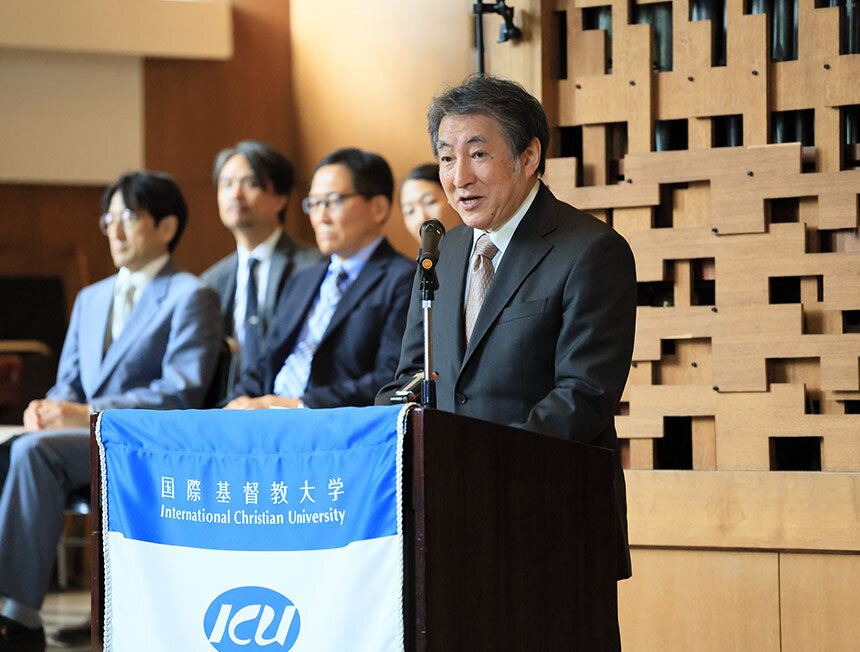
その後、献学以来の伝統に則り、学部・大学院の新入生一人一人の名前が読み上げられ、岩切正一郎学長より新入生へ、激励の式辞が述べられました。そして、新入生代表が世界人権宣言の原則に立ち本学での学生生活を送ることを誓う「学生宣誓」を読み上げ、学生全員が「学生宣誓」に署名を行いました。
式は英語で行なわれ、岩切学長の式辞も英語で読まれました。学長式辞の英文に続く日本語はその翻訳です。
岩切正一郎学長 式辞(全文)
A warm welcome to all of you who are entering our College of Liberal Arts and our MA and PhD programs. At the same time, I extend my warmest regards to all your family members and friends who are joining us online.
In the 18th century, during the Age of Enlightenment, there was a French playwright named Beaumarchais. Some of you may enjoy Mozart's opera 'The Marriage of Figaro' or Rossini's 'The Barber of Seville; Beaumarchais wrote the original plays upon which these operas are based.
He wrote in his essay on drama: "I leave the theater a better person than when I entered" ( "Je sors du spectacle meilleur que je n'y suis entré"). As a writer of the Enlightenment, he believed in human progress. On the stage, it is true that under the eyes of the audience, misfortunes and absurdities are represented, but a drama can let us consider human truths and the underlying causes of what happens in life and in society. We can also have a vision of happiness and, through emotions we feel, we can fortify our reason and become better individuals.
The notion of self-improvement was by no means confined to the Enlightenment era. Even in ancient Greece, Socrates says in one of Plato's works that' the essential thing is not living, but living well.'
You have newly matriculated into International Christian University. While it may seem odd to contemplate your departure at the very moment of your arrival, I hope that, much like Beaumarchais leaving the theater a better person than when he entered, you will become better human beings through your academic activities at ICU. And as Socrates advocated, rather than simply living — or in the context of academic life, merely studying or acquiring technical skills — may your learning serve to enrich your soul, grounded in a genuine love for wisdom.
The liberal arts education in which you are about to engage represents precisely this tradition. I ask that you hold fast to the pursuit of living well and becoming better individuals. As on the stage, the issues you will confront in your coursework and thesis writing will not always be merry or comfortable. Indeed, the opposite is more likely. In higher education, as we deliberate upon fundamental truths and conditions regarding human nature, history, society, and the natural world, we must inherently face the deep-seated conflicts and questions they include.
Since its founding, ICU's mission has been to nurture students to become international citizens, or in today's terms, global citizens, and peacebuilders. And from the outset, ICU has valued individuality, freedom, democracy, equity, dialogue, internationalism, diversity and critical thinking.
To achieve this mission, ICU fosters continuous discussions between students and faculty from diverse academic perspectives. Through this sharing of knowledge, we seek to bring into our field of perception that which has not yet been fully captured by current human knowledge — or has been obscured by knowledge itself.
We seek to deepen our comprehension of a world where freedom and happiness are compromised by violence, bondage, and the fractures that run through society and the human heart. At the same time, we seek paths toward peace and reconciliation, while exploring the beauty that sustains humanity at the deepest level of our existence.
As of today, you become members of this liberal arts community. Liberal arts education consists not only of learning in the classroom, but also of studying abroad, service-learning, student club activities, and the connections you make on campus. Through these diverse opportunities, I hope you will gain a wealth of experiences that will nourish your life.
The Scripture reading presented earlier was the parable of the sower, taken from the Gospel of Matthew. Shortly after this parable, Jesus Himself elaborates on its deeper significance — I invite you to consult the Scriptures later to reflect on it in full.
For my part, I'd like to mention its essence. Jesus teaches that we ought to become good soil. The term "good soil" signifies "someone who hears the word and understands it." For a word does not bear fruit merely by being heard, but when its meaning is truly comprehended.
Though rooted in faith, this lesson speaks directly to the nature of academic pursuit in higher education. Throughout your journey at ICU starting today, may you encounter words that take deep root, nurture those fruitful words within your lives, and harvest rich fruits in abundance.
Congratulations on your matriculation.
教養学部ならびに大学院博士前期課程・後期課程新入生の皆さま、ご入学おめでとうございます。また、ご家族、ご親戚、ご友人の皆様にも、心よりお祝い申し上げます。
18世紀、啓蒙主義時代のフランスに、ボーマルシェという劇作家がいました。みなさんのなかには、モーツァルトのオペラ『フィガロの結婚』やロッシーニのオペラ『セビリアの理髪師』が好きな方もいらっしゃると思います。そのもとになった戯曲を書いた作家です。
そのボーマルシェは演劇についてのエッセイのなかで次のように書いています。「私は劇場に入ったときよりも良い人間となって劇場を出る。」( « Je sors du spectacle meilleur que je n'y suis entré. »)彼は啓蒙主義の作家として、人間の進歩を信じていました。舞台の上ではいろいろと不幸なことや理不尽なことも起こりますが、にもかかわらず、観客はそれを観ながら、人間の真実について考えを深め、人生や社会の出来事の原因について思いをめぐらし、幸福のイメージを得て、心を動かされ、理性を強め、より良い人になるのです。
自分をより良くするというのは、もっぱら啓蒙主義時代に限った考え方ではありません。古代ギリシャでも、プラトンの描くソクラテスは、「大切にしなければならないのは、ただ生きるということではなくて、よく生きるということなのだ」と言っています。
みなさんは、国際基督教大学に入りました。入った早々、出ることを考えるのも変な話ですが、ちょうどボーマルシェが、入ったときよりも良い人間となって劇場を出るように、みなさんも、これからの学びと研究を通じて、今よりもよい人となっていただければと思います。そして、ソクラテスが言うように、ただたんに生きるのではなく、あるいは学生生活についていえば、ただたんに勉強するだけではなく、また、たんに知識やスキルを身につけるだけではなく、魂をより良くするための学び、知恵への愛に支えられた学びをしていただければと思います。
これからみなさんが身を置くリベラルアーツの学びとは、まさにそのような教育です。よく生きること、より良い人間となること、そのことを忘れないでいてください。舞台の上でと同じように、みなさんがこれから授業や論文執筆で取り組む問題は、必ずしも楽しく明るいことばかりを対象とするわけではありません。むしろその逆でしょう。大学で、私たちは、人間存在や歴史や社会や物理的世界の真実や条件について考えるのですから、当然、それが抱え込んでいるさまざまな問題や課題と向き合うことになります。
ICUのミッションは、その創設時から、学生を国際的市民、今の言葉で言えばグローバル・シティズンへ、そして平和を構築する人へ育てることであり続けています。 その理念のもとに、ICUは個としての人格、自由、民主主義、公正、対話、国際主義、多様性、そして批判的思考を大切にしてきました。
そのミッションを実現するために、ICUでは、多角的な学術的視点から、学生と教員がつねにディスカッションしつつ、知識を共有し、現在の人類の知識ではまだ捉え切れていないもの、あるいは知識によってかえって見えなくなってしまっているものを、認識のフィールドに運び込もうとしています。社会や心のなかに走る亀裂や、暴力や、束縛によって自由や幸福を奪われている世界についての理解を深め、平安や和解への道を探り、あるいは、存在の一番深いところで人間の支えとなる美しさを探究しています。
今日からみなさんも、その、リベラルアーツの共同体の一員です。リベラルアーツは、教室での学びだけではなく、留学や、サービスラーニングや、サークル活動や、キャンパスでの出会いによっても構成されています。さまざまな機会を通じて、人生の糧となる多くの経験を重ねてください。
先ほど私たちが聞いた「聖書朗読」は、「マタイによる福音書 」のなかの、「種を蒔く人」の譬え話でした。
その譬え話のすぐ後で、イエス様は、その譬えはどのような意味を持っているのかを、ご自身で説明されています。詳しくは、みなさん、後で聖書をひらいて確かめてください。
あえてそのポイントだけ挙げるなら、私たちは良い土地でなければならない、ということをイエス様は語られました。良い土地、とは、言葉を「聞いて悟る人」(someone who hears the word and understands it)のことを指しています。言葉は、たんに聞くだけではなく、その意味を理解されることによって、多くの実を結ぶというのです。
これは信仰についての話ですが、大学や大学院での学びや研究にも通じています。みなさんが、今日から始まるICUでの学生生活を通じて、自分の中に深く根を張る言葉、実りをもたらす言葉と出会い、それを自分の人生のなかで育て、多くの実りを得ることを願っています。
ご入学、おめでとうございます。